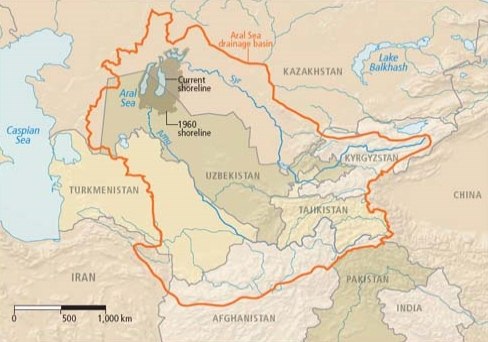
(PONARS Eurasia Policy Memo) In the mid-1980s, the international community became aware of the scope of a major environmental disaster in the Soviet Union. The Aral Sea, once the world’s fourth largest lake, had dramatically shrunk in the middle of the vast Central Asian steppe. After the Soviet Union collapsed, many policy analysts became concerned that the Aral Sea’s deterioration could have severe security repercussions.
The prevailing sense in the early 1990s was that new threats would generally be diffuse and come from “unconventional” sources. International connectedness could reduce tensions but it could also be a curse, particularly in relation to environmental resources. Drawing on the idea of “resource wars,” commentators suggested that we were entering a new era of fighting over scarce resources—an idea that was popularized by the likes of Robert Kaplan’s 1994 The Atlantic article, “The Coming Anarchy.”
Among these resource-related conflicts, the specter of “water wars” loomed exceptionally large in a world rapidly depleting its freshwater reserves—and even more so in the arid regions of the world like Central Asia. At a time when the Aral Sea basin was being carved up among a number of sovereign states, the dried-up lake seemed a prime candidate for pushing the region to the brink of war over water; the International Crisis Group, a nongovernmental organization, even issued a 2002 report on the alleged danger.
With Central Asia’s newly independent states jockeying for control of regional resources, in the 1990s and early 2000s international organizations such as the United Nations, World Bank, and OSCE invested heavily in promoting regional environmental cooperation frameworks with an explicit agenda of preventing the “coming anarchy” of water wars in Central Asia.
It turned out, however, that the region’s pending water wars were imagined. While programs and institutions to prevent conflict had some positive effects, it is too simplistic to suggest that these international institutions actually prevented the outbreak of water wars in the Aral Sea basin. So what explains their absence? The answer is that it is the political climate in which scarcity occurs, not scarcity itself, that makes war likely. Not only are policymakers generally inclined to avoid conflict, in Central Asia the elites personally benefited from the influx of development aid, and they were content to let peripheral areas, not metropolitan centers, bear the brunt of the costs.
Why There Were No Water Wars in Central Asia
To explain why no fighting has occurred in Central Asia over water, it is useful to situate the case within a global and historical context that can shed light on some key reasons. While certainly not an exhaustive list, the following three are a start.
1. The water wars thesis is specious.
Superficially appealing, the idea of resource wars actually has little theoretical or empirical merit—especially with respect to water. Many scholars have pointed out that there are almost no historical cases where water shortages have led to armed conflict. Instead, water scarcity is far more likely to result in cooperation.[1]
The main problem with the resource wars idea is that it tends to neglect the fact that scarcity is not a “natural” phenomenon, but one that is politically constructed. Take the Aral Sea for example: Central Asia would not necessarily be facing water shortages if the Soviet-era Virgin Lands Campaign had not created a sudden demand for copious supplies of usage in the arid steppe, which was siphoned off from the Amu Darya and Syr Darya Rivers that feed the sea. Thousands of miles of unlined trenches and canals might not have been dug, and the sixty percent of that water that was lost to evaporation and seepage instead might have made it to the sea or downriver communities.
Water “scarcity” in Soviet Central Asia was therefore a result of various political decisions and behaviors—from high-ranking government planners down to local farmers. But water shortages were not expected to lead to fighting in Soviet Central Asia because the entire area was part of one country, which was invested in promoting internal cooperation. The political context was the most important reason scarcity did not lead to fighting.
More generally, as geographers and other environmental scholars have shown, scarcity is never a cause but an intervening variable that might result in violence. The political climate in which scarcity occurs is what makes war likely, not scarcity itself. As Central Asia transitioned into the post-Soviet period, the region’s political climate was still not prone to inter-state conflict because, as the next point suggests, water cooperation turned out to offer many benefits for the states.
2. Water sharing and cooperation created opportunities for the Central Asian states.
Predictions of water wars in Central Asia were often tied to the question of how the regional states would deal with water as a shared resource, as new barriers and borders were being erected. The Aral Sea disaster was suddenly transformed from a “domestic” water crisis into a problem of interstate relations for the region, with newly independent states vying for water rights to the rivers that feed into the sea.
Without considering geography, this perspective might make sense. However, given their terrain, the upstream states where the rivers originate, such as Tajikistan, can only use so much water, with the rest eventually making its way to downstream countries. Similarly, for the downstream states, such as Uzbekistan, vast cropland means that they can offer food and other agricultural products unavailable or more expensive in the more mountainous states. For both upstream and downstream states, then, access to water creates a significant bargaining opportunity. Downstream states are never simply passive victims, nor are upstream states necessarily antagonistic toward their neighbors.
Policymakers in both contexts are far more inclined to avoid conflict and instead actively work to secure what they want (whether that is water or something else in exchange for water, like subsidized agricultural products)—and they will undertake all sorts of bargaining, backdoor deals, and even strong-arming to make that happen. Picking up arms would nullify these opportunities.
Similarly, as noted above, the international aid community was particularly concerned with deterring conflict over water in the Aral Sea basin in the 1990s, believing that it was a looming and inevitable threat. While the sea’s eventual demise was more or less a foregone conclusion, numerous organizations were set up to facilitate interstate cooperation and dialogue regarding water sharing and remediation efforts in the Aral littoral communities (such as a joint World Bank and United Nations’ Aral Sea Basin Program). Participating in these initiatives often brought economic incentives that were substantial for the suffering economies of the region at the time.
Ironically, international intervention actually “worked” from the perspective of promoting stability—albeit for the wrong reasons and for the wrong people. Perhaps predictably, funds for projects large and small quickly found their way into the hands of elites. Treated by elites as another kind of opportunity, conflict prevention and aid programs related to the Aral Sea disaster helped shore up elites and further entrench the local patronage of water administrators. That said, international donors quickly lost patience for regional corruption and for seeing aid money enrich politicians, and most projects disintegrated by the early 2000s.
3. The stakes were too low for armed conflict over water in Central Asia.
Given the economic and political opportunities that cooperation presented to elites, conflict would not have been in their interest. Furthermore, the burden of the Aral Sea disaster and regional water mismanagement has always been unevenly distributed. When people lack access to water in their homes, or when farmers have their water cut off at important times in the growing cycle, or when people suffer from respiratory ailments due to the region’s pesticide-laden dust storms—these are things that disproportionately affect mostly peripheral rural populations.
As shown by interviews and ethnographic research I conducted in 2005 and 2015, residents of many villages in the North Aral Sea region of Kazakhstan feel intensely powerless to affect change regarding the ecological situation, and many find the region’s large unemployment and underemployment rates to be a much more pressing challenge than access to water. The overwhelming attitude is that the matter should be resolved by government officials, or that whether there is water or not is a question of God’s will. Either way, these individuals expressed no inclination to take matters into their own hands through initiating some sort of armed action. Such efforts, from their point of view, would be worse than futile. In short, those most impacted by regional water problems—those for whom the stakes are highest—have never posed a threat to peace, while elites who are heavily invested in leveraging the threat to peace are actually not at all interested in investing the resources that would be required for fighting over water.
Lastly, the recent unique trajectory of Kazakhstan has also shaped today’s picture of water relations. Given its resource wealth and political efforts to diversify into sectors beyond agriculture, the country has been able to move away from the most water-intensive crops like cotton, wheat, and rice, unlike its southern neighbor Uzbekistan. This, combined with a World Bank-funded project to build a dike between the North and South Aral Sea, has allowed the government to reduce its use of the Syr Darya River and promote the refilling of the North Aral. While the North Aral represents only ten percent of the original sea’s size, Kazakhstan’s government has presented its rejuvenation as a major victory, and although regional poverty still prevails, conditions in the area are slowly improving. Overall, Kazakhstan’s ability to plot a different trajectory—one that is not bound intensely to water resources—means that “scarcity” has not been constructed as a major development challenge, and certainly not an existential threat worth fighting over.
Conclusion
What can the Aral Sea disaster tell us about environmentally-related security threats in Eurasia? The costs and benefits of environmental change associated with the Aral Sea’s desiccation have historically been unevenly distributed. Elites with the power to make decisions about water policies have historically benefited from them, while the periphery has tended to bear the brunt of the costs.
This is generally the case of environmental degradation throughout Eurasia—and indeed the entire world. Whether it is water mismanagement in Central Asia, nuclear catastrophe in Chernobyl, or heavy-metals pollution in Norilsk, those most impacted tend to be marginal populations whose homelands and bodies are contaminated as a result of political decisions about how to use states’ natural resources.
As the 1990s fixation with “resource wars” suggests, sensational narratives about armed conflict over resources can actually be used for more ill than good. Ostensibly aiming to galvanize policymakers and ordinary citizens into caring for the environment and the planet’s limited resources, narratives that construct scarcity as a natural—rather than political—phenomenon threaten to divert attention from the underlying social and political inequalities that resulted in unsustainable practices in the first place. So while the absence of violent conflict is always a positive outcome, policymakers should be concerned about the extreme inequalities that this “success” is built upon, and instead consider social justice as a more sustainable goal than stability in promoting regional security.
Natalie Koch is Assistant Professor in the Department of Geography at Syracuse University’s Maxwell School of Citizenship and Public Affairs.
[PDF]
[1] For a brief discussion, see: “Dehydrating Conflict,” Foreign Policy, November 18, 2009.