PONARS Eurasia
  • About Us
    • Contact Us!
    • Membership
      • All Members
      • Core Members
      • Collegium Members
      • Associate Members
      • About Membership
    • Our Ukraine Experts
    • Executive Committee
  • Our Ukraine Experts
  • Policy Memos
    • List of Policy Memos
    • PONARS Eurasia’s Newest eBooks
    • Submissions
  • Online Academy
  • Events
    • Past Events
  • Recommended
  • Task Forces
    • Ukraine
      • PONARS Ukraine Task Force: Incontrovertible Truths
    • Amplifying Voices of Europe, the Caucasus, and Central Asia (AVECCA)
    • Russia in a Changing Climate
  • Podcasts
Contacts

Address
1957 E St NW,
Washington, DC 20052

[email protected]
202.994.5915

NEWSLETTER
Facebook
Twitter
YouTube
Podcast
PONARS Eurasia
PONARS Eurasia
  • About Us
    • Contact Us!
    • Membership
      • All Members
      • Core Members
      • Collegium Members
      • Associate Members
      • About Membership
    • Our Ukraine Experts
    • Executive Committee
  • Our Ukraine Experts
  • Policy Memos
    • List of Policy Memos
    • PONARS Eurasia’s Newest eBooks
    • Submissions
  • Online Academy
  • Events
    • Past Events
  • Recommended
  • Task Forces
    • Ukraine
      • PONARS Ukraine Task Force: Incontrovertible Truths
    • Amplifying Voices of Europe, the Caucasus, and Central Asia (AVECCA)
    • Russia in a Changing Climate
  • Podcasts
DIGITAL RESOURCES
digital resources

Bookstore 📚

Knowledge Hub

Course Syllabi

Point & Counterpoint

Policy Perspectives

RECOMMENDED
  • The ‘Don’t Lose Lukashenko’ Approach: Kyiv’s (Non-) Strategic Ambiguity Toward the Belarusian Opposition

    View
  • Too Much, Too Late? The Impact of Secrecy on Efforts to Mediate an End to the Russia-Ukraine War

    View
  • A Deal with the Devil: Lukashenko Navigates Domestic and External Vulnerabilities in Managing Relations with Russia

    View
  • Peacemaking Russian Style: Negotiations as the Continuation of War by Other Means

    View
  • ‘DIY Warfare’: How Russia Crowdsources the Battlefield in Ukraine

    View
RSS PONARS Eurasia Podcast
  • The Putin-Xi Summit: What's New In Their Joint Communique ? February 23, 2022
    In this week’s PONARS Eurasia Podcast, Maria Lipman speaks with Russian China experts Vita Spivak and Alexander Gabuev about the February meeting between Vladimir Putin and Xi Jinping, and what it may tell us about where the Russian-Chinese relationship is headed.
  • Exploring the Russian Courts' Ruling to Liquidate the Memorial Society January 28, 2022
    In this week’s PONARS Eurasia Podcast, Maria Lipman chats with scholars Kelly Smith and Benjamin Nathans about the history, achievements, and impending shutdown of the Memorial Society, Russia's oldest and most venerable civic organization, and what its imminent liquidation portends for the Russian civil society.
  • Russia's 2021 census and the Kremlin's nationalities policy [Lipman Series 2021] December 9, 2021
    In this week’s PONARS Eurasia Podcast, Maria Lipman chats with social scientist Andrey Shcherbak about the quality of the data collected in the recent population census and the goals of Vladimir Putin's government's nationalities policy
  • Active citizens of any kind are under threat [Lipman Series 2021] November 5, 2021
    In this week’s PONARS Eurasia Podcast, Maria Lipman chats with Alexander Verkhovsky about the Kremlin's ever expanding toolkit against political and civic activists, journalists, and other dissidents.
  • Russia's Legislative Elections followup [Lipman Series 2021] October 4, 2021
    In this week’s PONARS Eurasia Podcast, Maria Lipman chats with Tanya Lokot and Nikolay Petrov about the results of Russia’s legislative elections and about what comes next.
  • Why Is the Kremlin Nervous? [Lipman Series 2021] September 14, 2021
    In this week’s PONARS Eurasia Podcast, Maria Lipman chats with Ben Noble and Nikolay Petrov about Russia’s September 17-19 legislative elections, repressive measures against electoral challengers, and whether to expect anything other than preordained results.
  • Vaccine Hesitancy in Russia, France, and the United States [Lipman Series 2021] August 31, 2021
    In this week's PONARS Eurasia Podcast episode, Maria Lipman chats with Denis Volkov, Naira Davlashyan, and Peter Slevin about why COVID-19 vaccination rates are still so low across the globe, comparing vaccine hesitant constituencies across Russia, France, and the United States.  
  • Is Russia Becoming More Soviet? [Lipman Series 2021] July 26, 2021
      In a new PONARS Eurasia Podcast episode, Maria Lipman chats with Maxim Trudolyubov about the current tightening of the Russian political sphere, asking whether or not it’s helpful to draw comparisons to the late Soviet period.
  • The Evolution of Russia's Political Regime [Lipman Series 2021] June 21, 2021
    In this week's episode of the PONARS Eurasia Podcast, Maria Lipman chats with Grigory Golosov and Henry Hale about the evolution of Russia's political regime, and what to expect in the lead-up to September's Duma elections.
  • Volodymyr Zelensky: Year Two [Lipman Series 2021] May 24, 2021
    In this week's episode of the PONARS Eurasia Podcast, Maria Lipman chats with Sergiy Kudelia and Georgiy Kasianov about Ukrainian President Zelensky's second year in office, and how he has handled the political turbulence of the past year.
  • Recommended | Рекомендуем

The Myth of Syrian Mercenaries in Karabakh Debunked in Eight Parts

  • November 6, 2020
  • Anar Valiyev

(PONARS Eurasia Commentary) From the beginning of the escalation of the conflict in the Karabakh region of Azerbaijan, some accusations were aired in several European and Russian mainstream media about the involvement of Middle Eastern militants and mercenaries in the fighting. Some of the articles accused Azerbaijan and Turkey of involving Syrian militant groups in Karabakh. Other stories claimed that Yerevan had drawn in Lebanese-Armenian militants and even the (Russian) Wagner paramilitary group. Both Armenia and Azerbaijan have demonized each over these months to win support and sympathy regionally and globally. A brief analysis is provided here about the (non)possibility of mercenaries and militants from the Middle East in the conflict.

Stories Emerge

In September, unclear reports from the BBC Arabic news service, Guardian, and Reuters mentioned the possibility of Syrian mercenaries in Karabakh fighting for Azerbaijan. The BBC article said an interviewed Syrian militant claimed that hundreds of residents from Turkish-controlled Syrian territories were recruited into Azerbaijan.

An article in the Independent under the title: “’We don’t even know where Azerbaijan is’: The Syrian mercenaries driven by poverty to die in a distant war,” wrote about the death of fighter Mohammed Al-Shuhna in the conflict. The article claimed, without any reliable evidence and based only on records of his friends, that Al-Shuhna was killed in Azerbaijan in battle, and even that fifty similar paid fighters also died. The Asia Times, Wall Street Journal, France 24, and some other outlets (including Armenian and Russian) also ran brief stories. A somewhat common angle was that the fighters were in Karabakh at the behest of Turkey.

Accusations of Syrian mercenaries have haunted Azerbaijanis as they see stories of up to 4,000 militants and mercenaries being involved in their country. The Armenian side has claimed they captured several of them, but no evidence has been presented. The best media evidence has been some interviews with unknown Syrians.

Looking More Closely

Accounts of foreign mercenaries and militants joining the battlements are unreliable. First, thousands of “extra” troops fighting Armenians in Karabakh is nonsensical. Most of the articles claim there were about 1,000 mercenaries and some outlets such as the BBC and the Guardian wrote there were 4,000. It would take sophisticated logistics for Baku to transport and house hundreds or thousands of “hidden” fighters. (The higher the number, the higher the chance of actual photographs or videos circulating on the Internet.)

Second, it is illogical for Azerbaijan to hire mercenaries from Syria because they are not suited to the Azerbaijani terrain in terms of military specialization. Generally, Syrians have experience in Syria, Libya, Afghanistan, and other desert landscapes, but the conflict terrain here is mountainous and forested.

Three, to be effective in modern warfare, it is necessary to have good lines of communication with fellow soldiers. The Azerbaijani language is not Arabic and it is difficult to incorporate foreigners into the regular army. There are also high risks that a mercenary might turn his weapons on his host.

Four, most Syrian mercenaries are from Sunni-based organizations and it would be abnormal for them to fight for nominally Shi’a Azerbaijan.

Five, governments do not want unruly mercenaries in the shadows. They are difficult to control and can be dangerous to local populations. Azerbaijan has an extremely strict law against mercenary activities with a punishment of 25 years in jail.

Six, it is not the first time that accusations have been thrown at Baku from Yerevan. In 2016, after the so-called “April war” in Nagorno-Karabakh, Armenian and some major Russian media outlets disseminated propaganda about the involvement of ISIS on the Azerbaijani side. The goal appeared to be trying to legitimize a foreign intervention involving Russia.

Seven, over the last two decades, Azerbaijan has been an active member of anti-terror coalitions. As a U.S. State Department report writes: “In 2019, the Azerbaijani government actively worked to deter, detect, and defeat terrorist efforts to move people, money, and materials across its land.” Its army has participated with British and U.S. forces in Kosovo, Iraq, and Afghanistan and has removed jihadists from the Northern Caucasus during the Chechen-Russian war.

Eight, a verified photograph or video from the conflict zone showing Azerbaijan’s use of mercenaries would deeply impair Baku’s reputation as a reliable regional or international coalition partner.

Granted, foreign fighters continue to join forces in conflict zones around the world, however, it is unnecessary and ineffectual for Azerbaijan to use mercenaries and dangerous for the government to have any such connections. Nevertheless, articles about “Syrian recruits” can be found among European, Armenian, and Russian media outlets.

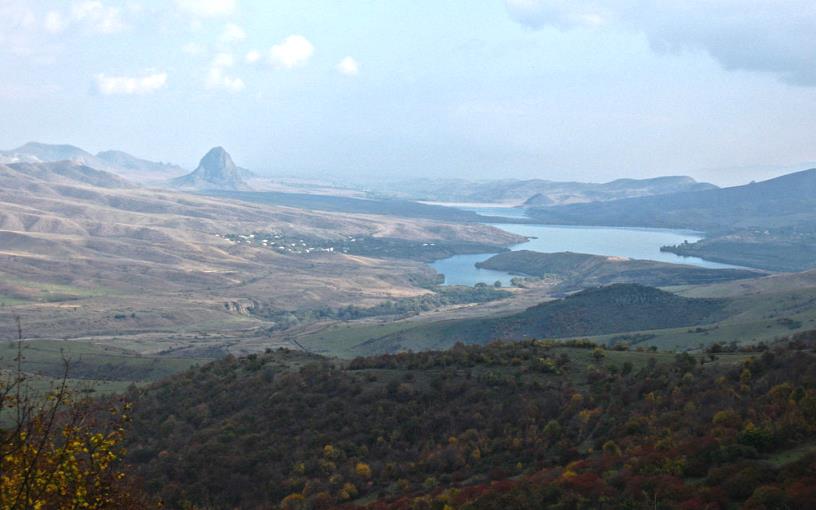
Homepage image: Armenian-Azerbaijani border (credit/license)
Related Topics
  • Armenia
  • Azerbaijn
  • Nagorno-Karabakh
  • Russia
  • Syria
  • Valiyev
Previous Article
Uncategorized

Elections, Protest, and Authoritarian Regime Stability: Russia 2008-2020

  • November 5, 2020
  • Regina Smyth
View
Next Article
  • Recommended | Рекомендуем

Greene: Conflict with the West and the US in particular form an important part of Putin’s legitimacy

  • November 9, 2020
  • PONARS Eurasia
View
You May Also Like
View
  • Policy Memos | Аналитика
  • Recommended | Рекомендуем

The ‘Don’t Lose Lukashenko’ Approach: Kyiv’s (Non-) Strategic Ambiguity Toward the Belarusian Opposition

  • Boris Ginzburg
  • February 23, 2026
View
  • Policy Memos | Аналитика
  • Recommended | Рекомендуем

Too Much, Too Late? The Impact of Secrecy on Efforts to Mediate an End to the Russia-Ukraine War

  • Mikhail Troitskiy
  • February 23, 2026
View
  • Policy Memos | Аналитика
  • Recommended | Рекомендуем

A Deal with the Devil: Lukashenko Navigates Domestic and External Vulnerabilities in Managing Relations with Russia

  • Ryhor Nizhnikau and Arkady Moshes
  • February 9, 2026
View
  • Policy Memos | Аналитика
  • Recommended | Рекомендуем

Peacemaking Russian Style: Negotiations as the Continuation of War by Other Means

  • Pavel Baev
  • January 26, 2026
View
  • Policy Memos | Аналитика
  • Recommended | Рекомендуем

‘DIY Warfare’: How Russia Crowdsources the Battlefield in Ukraine

  • Mariya Omelicheva
  • January 26, 2026
View
  • Policy Memos | Аналитика
  • Recommended | Рекомендуем

Russia’s Loss of Reputation and Status in the Middle East: Potential Consequences for Putin at Home and Abroad

  • Kimberly Marten
  • January 12, 2026
View
  • Policy Memos | Аналитика
  • Recommended | Рекомендуем

Where Concessions Meet Resolve: How Ukrainian Society Sees U.S. Efforts to End Russia’s War

  • Mikhail Alexseev and Serhii Dembitskyi
  • December 22, 2025
View
  • Policy Memos | Аналитика
  • Recommended | Рекомендуем

Hammering In the Last Nail: Georgian Dream Targets Universities

  • Stephen F. Jones
  • December 22, 2025

Leave a Reply Cancel reply

Your email address will not be published. Required fields are marked *

PONARS Eurasia
  • About Us
  • Membership
  • Policy Memos
  • Recommended
  • Events
Powered by narva.io

Permissions & Citation Guidelines

Input your search keywords and press Enter.