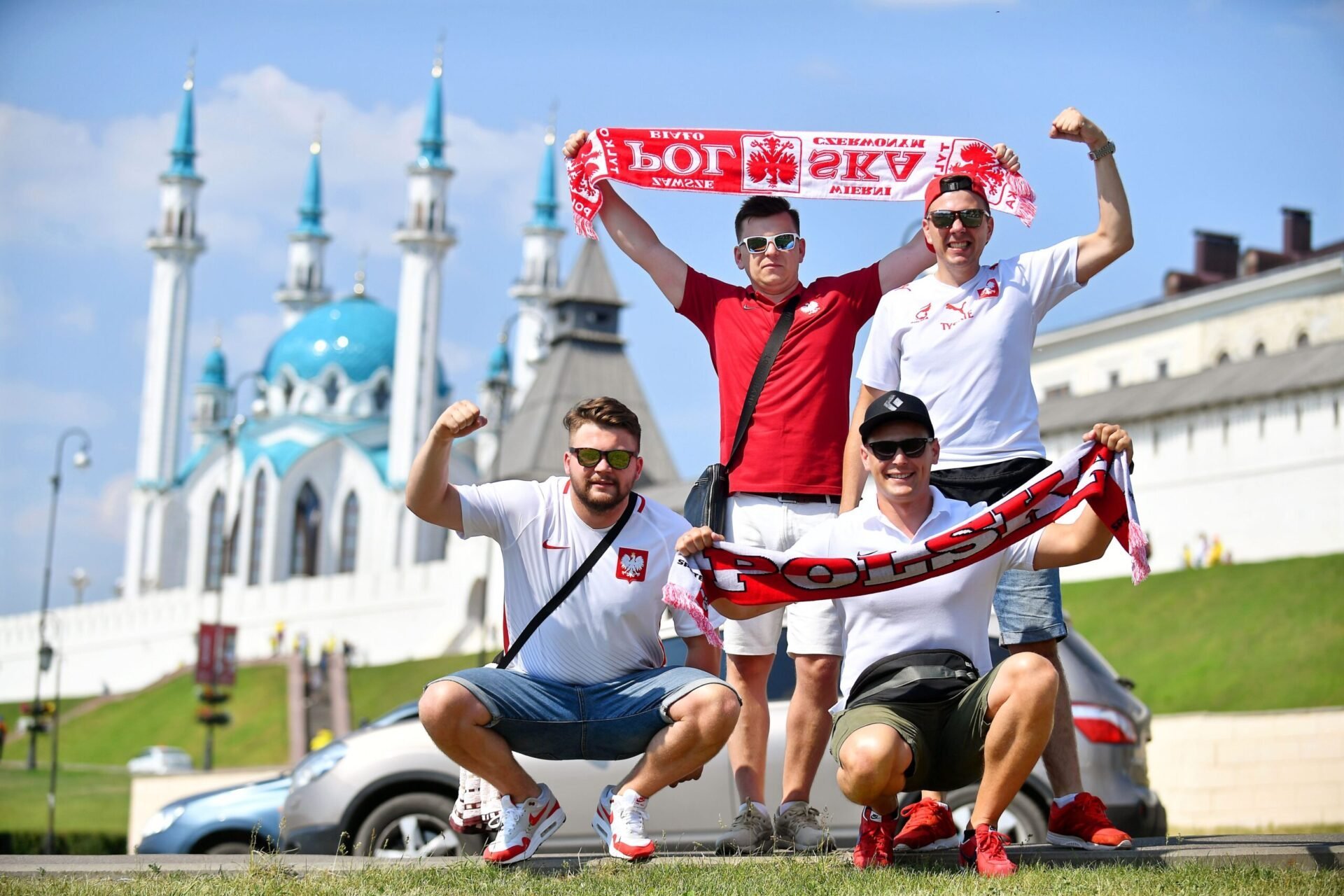

Polish fans at the World Cup in Kazan.
► As Richard Arnold explains, hosting the FIFA World Cup has been a PR coup for Russia, mostly living up to official expectations (though with some caveats), and, at least so far, a popular success.
The architect of the international sporting movement in the modern age, the Baron de Coubertain, declared that sport was peace, and dreamed of a world in which sport helped to uphold a peaceful world order. More recently, Nelson Mandela once called sport “the most powerful means of diplomacy in the modern world,” speaking in reference to the 1994 Rugby World Cup held in South Africa. Numerous analysts have seen Sporting Mega Events (SMEs) as an opportunity for the host nation to project “soft power.”
Such aspirations seem apposite for a Russia which today finds itself shunned by the international world order and subject to sanctions following protests at the annexation of Crimea, alleged intervention in Western elections, and the alleged poisoning of former intelligence agent Sergei Skripal in the British city of Salisbury. Can Moscow use the World Cup to improve its international standing? How might this year’s World Cup, the largest sporting event on the planet, improve Russia’s standing in the eyes of the world? This brief essay looks at opportunities for public diplomacy, overturning stereotypes, elite meetings, and continuing obstacles surrounding the 2018 FIFA World Cup in Russia.
|
People who would otherwise have had no reason ever to visit the country are going to be returning home and raving about the hospitality of the hosts, the richness of Russian culture, and the modernity of the country’s infrastructure.
|
One of the most important diplomatic functions of sport is to act as a chance for public diplomacy, allowing ordinary people to experience another society directly, without the influence of the media coloring expectations. The concept of public diplomacy (even if not this exact phrase) is nothing new, yet Joseph Nye hailed it as assuming even greater importance in the post-Cold War era as an essential component of a state’s “soft power.” Nor is this Russia’s first venture into public diplomacy through sport- the 2014 Winter Olympics in Sochi also performed this function, although soft power gains were quickly sacrificed. But the World Cup seems to be a much more comprehensive means of public diplomacy than the Olympics, as the former is played throughout the [European part of] the country and not solely in one highly unusual city close to an ethnically distinct region.
So far, the 2018 World Cup appears to have been a great success in terms of public diplomacy. The leader of “CSKA fans against racism,” Robert Ustian, has encouraged ordinary fans “to come to Russia” and made numerous appearances on media outlets throughout the world. In one appearance, Ustian even directly compared the World Cup to military conflicts from Russia’s past, saying “for the first time in history, since Napoleon and Hitler, so many international fans come to our soil, our Russia, but this time without weapons.” His optimism has been well-rewarded, as visitors to Russia have remarked on how friendly and welcoming the people are. After England’s thrilling 2-1 victory over Tunisia in Volgograd, for example, many fans reported to the media that Russia was nothing like they had been told. Football fan James Lockett told the Independent that the Russians were “nothing but friendly.” People who would otherwise have had no reason ever to visit the country are going to be returning home and raving about the hospitality of the hosts, the richness of Russian culture, and the modernity of the country’s infrastructure.
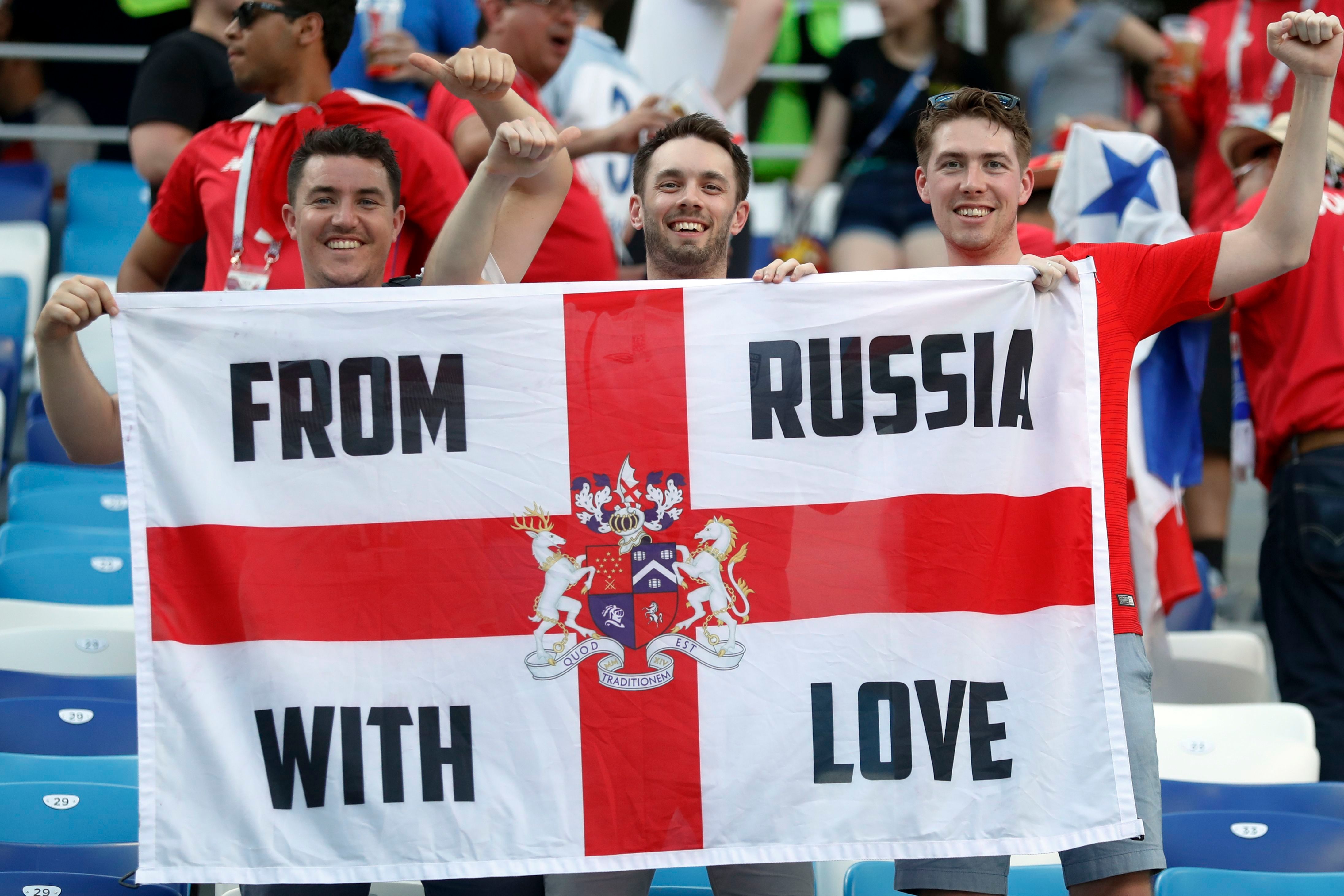
English fans at a World Cup stadium.
Indeed, challenging preconceptions of Russian backwardness and stereotypes about the stolid nature of its people was one of Putin’s stated aspirations from the games. Polling of Russian students from the Russian sociological association suggested that students’ main international hopes from the World Cup were “as a source of positive emotions” (19.7%), to “improve international relations” (18%), and “the growth of Russia’s authority in the world” (15.7%). The image of dour, cold Russia, the hostility of Russians, and fears about speaking English on the Moscow Metro have achieved the status of folklore in the West. British foreign secretary Boris Johnson even compared the 2018 World Cup with the 1936 Berlin Olympics- a clumsy, bumbling comparison that may actually have contributed to the success of the event by encouraging ridicule of concerns. Yet during the games themselves, Russian taxi drivers have been taught limited English phrases, the police encouraged to smile and be helpful, and the public has become used to hearing foreign languages on the streets of even provincial Russian cities. At the same time, many soccer fans have expressed admiration at Moscow’s world-class metro system. Whether this will be a lasting change of opinion is difficult to say, although such changes have proven durable in other instances, such as Germany’s 2006 “fairytale” World Cup.
In one important respect, also, Russia has overturned conceptions held by ordinary Russians (as well as most Western commentators, including myself) of just how bad their own team was. At the most recent international soccer event prior to the World Cup, the UEFA 2016 finals, the Russian team had looked terrible and led many to predict that Russia would go down as one of only two hosts whose team had failed to make it out of the group stages (South Africa, in 2010, is the other). The polling of Russian students showed that over a fifth of respondents (21.2%) thought the sbornaya would not make it further than the groups. In my travels around World Cup host cities in 2016-17, this indeed was one of the main complaints of ordinary Russians and local journalists. Yet the victories of the Russian team (admittedly, against rather weak opponents) have ignited passion throughout the country and stimulated real belief that the national team might make a respectable performance in the World Cup.

A Russian and Uruguayan fan embrace at the World Cup.
It is not, however, all positive news. Georgetown University basketball coach and former U.S. sports ambassador Craig Ersherick lists as one of the contributions sport can make to improved diplomatic relations an unofficial chance for leaders to meet by the sidelines of the SME. Such informal meetings are often the most productive places to do business, especially as the eyes of the media are turned toward the action on the pitch. This was unlikely ever to be a particularly strong dividend of the World Cup given the failure of major nations like the United States and Italy even to qualify for the finals. Further, one sanction the British government applied after the Skripal poisoning in March was to ban British government officials (and, more superficially, the Royal family) from attending the matches. Putin seems to have used the World Cup to underline the fact that Russia is not, in fact, isolated, taking the chance to meet with Saudi Prince Mohammed bin Salman, U.N. Secretary-General Antonio Guterres, and South Korean President Moon Jae-in. If the England team makes it to the semifinals or the final, furthermore, there will be domestic pressure in the U.K. to send official delegates.
|
Putin seems to have used the World Cup to underline the fact that Russia is not, in fact, isolated, taking the chance to meet with Saudi Prince Mohammed bin Salman, U.N. Secretary-General Antonio Guterres, and South Korean President Moon Jae-in.
|
The cup is by no means finished. One can easily imagine how a sense of complacency could set in and actually jeopardize its success. Prominent opposition leader Alexei Navalny has called for a day of protests against the rise in the retirement age on July 1, though he has pledged not to hold protests in any World Cup host cities. While there have been protests from numerous sources concerning the retirement age, Navalny is particularly antagonistic to the Kremlin, and his planned protest contravenes a ban on public protests during either the Confederations Cup in 2017 or the World Cup in 2018.
There were also many concerns in the international community about racism and xenophobia in Russia. When Russian Duma Deputy (and chairwoman of the families committee) Tamara Pletnyova urged Russian women not to have sex with foreign fans due to the number of single mothers left after the 1980 Moscow Olympics and implied that if they had to then “it’s one thing if they’re of the same race, but quite another if they’re of a different race. I’m not a nationalist, but nevertheless.” The comments are an embarrassment for a Russia that has tried to present a tolerant and open face to the world. Putin’s spokesman Dmitry Peskov distanced the Russian administration from the remarks, saying that Russian women would choose for themselves with whom to have sex, while Piara Powar, the head of the Fare network (Football Against Racism in Europe) called them an example of “arrogant clumsiness.” Finally, Russia’s legendary hooligans have also not yet shown an appearance at the World Cup. Again, one can easily imagine that, were the domestic expectations for the team to rise or- especially- were they to meet England in the Quarter-Finals, this situation could change rapidly. While there are no signs that any such problems are in the offing, it would be premature to rule them out.
Similarly, all SMEs wherever they take place are targets for terrorists, and the FIFA 2018 World Cup is no different. Before the games began, ISIL militants made general threats to the safety of the games, as well as distributed leaflets showing the Volgograd arena in the background along with the legend “wait for us.” The final games of the World Cup will draw more eyes and hence a bigger prize for terrorists.
Russia’s World Cup thus seems to be an unqualified success for the hosts in promoting a positive view of the country and overturning negative stereotypes, at least so far. Ordinary Russians have been mingling with foreigners from all over the world (like the waitress Viktoria Latishova in Saransk who was excited at meeting her first American), those foreigners have discovered many beautiful and interesting things about Russia, and even some limited high-level diplomacy could be achieved. How long-lasting these developments will be -hopefully longer-lasting than the reputational gains from the Sochi 2014 Winter Olympics, lost even before the end of the closing ceremony by Russia’s invasion of Crimea- is uncertain, but there is reason to hope that hosting the world’s biggest party will create positive memories for a whole generation of Russians. For now, however, the only thing to do is to enjoy the football. Play on.

Richard Arnold is Associate Professor of Political Science at Muskingum University, where he teaches courses in comparative politics and international relations, including courses on Russian politics and the politics of sport. He is the author of Russian Nationalism and Ethnic Violence: Symbolic Violence, Lynching, Pogrom, and Massacre (2016, Routledge) and has published articles in many journals such as Theoretical Criminology, Problems of Post-Communism, and Post-Soviet Affairs. He (along with Andrew Foxall, Henry Jackson Society, London) was the guest editor for a special edition of Problems of Post-Communism on the 2018 World Cup and is currently working on an edited volume with a post-mortem of the World Cup and a monograph on Cossacks in Russia and Ukraine.