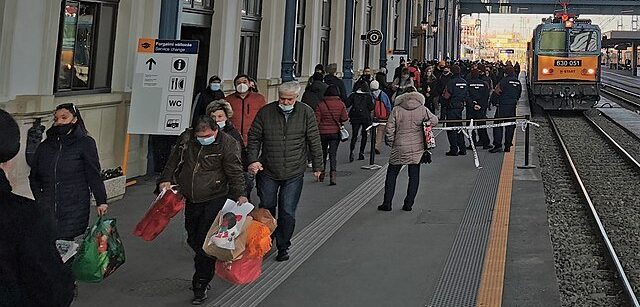
(PONARS Eurasia Commentary) Today we have a war and refugees in Europe. By Wednesday, March 2, six days of war had forced 677,00 Ukrainians[i] to leave the country and seek asylum. Ukrainians and foreigners living on its territory crossed into neighboring EU countries: 213,000 to Poland; 78,000 to Hungary; 26,000 to Slovakia; and 97,000 to Romania.[ii] These are not the final numbers of people needing to cross Europe’s borders. According to experts´ estimations, the forced outflow of the population from the war-struck country may reach up to 1-5 million people.[iii],[iv]
Contemporary humanitarian migration from Ukraine
Migrants are mainly women and children, simply because men age 18-60 are forbidden from leaving the territory of Ukraine due to universal military mobilization. These humanitarian flows and the fact that war has come to Europe did the impossible: for the first time in many years, EU countries are consistently accepting migrants and granting asylums. Humanitarian response to the war in Ukraine united Europe.
Countries of Eastern and Central Europe
Moldova was the first country to open its borders to Ukrainians on February 24. President Maia Sandu personally visited checkpoints at the Moldova-Ukraine border and inspected the preparedness of shelters for refugees in Palanca and Ochita. The Government of Moldova issued Resolution M3 # 166 on February 26, 2022, which guarantees the right to free medical services and treatment for Covid, HIV, and TB, as well as oncology, etc., and urgent surgeries.
Poland faced the heaviest humanitarian pressure. According to data from February 27, 2022, more than 200,000 Ukrainians crossed the Polish border. According to the Minister of the Interior Mariusz Kaminski, every Ukrainian may count on shelter in his country[v]. For this purpose, eight border checkpoints are open 24/7 at the Ukraine-Poland border,[vi] and the railways of Poland[vii] and Germany[viii] transport Ukrainian refugees in their territory
Slovakia[ix], Lithuania[x] and Estonia[xi] accept refugees without any special requirements for travel documents: the border may be crossed even with outdated papers and non-biometric passports and without visas. Lithuania accepts Ukrainian refugees through a simplified procedure: people are placed and registered at special centers for 72 hours and then given an opportunity to move to accommodations allotted by municipalities or citizens of Lithuania.[xii]
Czech Republic and other countries waived health requirements for entry for Ukrainians and their pets — no vaccinations and/or antigen tests are required[xiii].
Even Hungary, which refused to accept refugees from Syria during the 2014-2016 war, opened its doors to Ukrainians.[xiv] Prime Minister Victor Orban stated that “the country awaits Ukrainians and will receive them as friends.”[xv] It is an excellent example of humanitarian solidarity, especially from Hungary and the Baltic countries, although differential treatment of Syrian (2014) and Ukrainian (2022) refugees is evident.
Countries of Western Europe
Countries of Western Europe, which do not have shared borders with Ukraine, are also ready to accept refugees. On February 25, Ireland announced that it would lift all visa requirements for Ukrainian citizens and declared a simplified order for reunions with families and relatives holding Irish citizenship. It also declared that Ukrainians will have 90 days to establish their migration status on Irish territory.[xvi] Great Britain created a special family visa for Ukrainians who have close relatives with British citizenship, which will be issued within 24 hours. After filing a visa application, the visa is free for applicants.[xvii]
EU countries are unanimous in their response to the humanitarian crisis in Ukraine. Due to the visa-free regime of the EU and Ukraine, Ukrainians may enter and freely move within the territories of EU countries for 90-180 days. Today, the key issues are granting status for and guaranteeing the safety of Ukrainians after their 90 days have elapsed, as well as determining the legal status that could best protect people fleeing the war. Each EU country solves those matters individually. Austria[xviii] and Germany[xix] extended all issued visas and titles for citizens of Ukraine for another 90 days. In addition, citizens of Ukraine may seek asylum or subsidiary protection and may not be deported or exiled from either Austria or Germany.
Considering the possible number of refugees from Ukraine and the fact that the review of each application for asylum or subsidiary protection may take time, the EU will apply the Temporary Protection Directive to citizens of Ukraine.[xx] This means that Ukrainians will be treated as a special group of citizens from a non-EU country forced to massively flee, and they will be granted protection in EU countries along with medical services, access to labor markets and/or social allowances, and the possibility of reuniting with family or relatives under certain conditions for a term of 1-3 years.[xxi] Applying such a special order of the Directive to citizens of Ukraine excludes the possibility of filing individual requests for asylum or subsidiary protection.
Conclusion
Today, European countries, shaken by the horrors of war at their borders, have united to respond to the humanitarian disaster in Ukraine. What’s more, the EU Commission is proposing to activate the Directive on Temporary Protection of 2001[xxii] which was adopted as a reaction to the war and human exodus from the former Yugoslavia but has never been used in the EU. Its aim is immediate protection and rights for people feeling their country en masse. The Directive offers extraordinary support to Ukrainians including the issuance of residence permit, free movement within the EU, medical assistance, and access to education and the labor market.[xxiii] Never before has Europe known such unity on issues of migration and granting asylum. The humanitarian migration from Ukraine has completely reframed the continent’s asylum agenda. This is why the most difficult matter for years to come will be to keep such a human-friendly approach to all people in need.
Olga Gulina is Founder & CEO of the RUSMPI–Institute on Migration Policy.
[i]https://twitter.com/FilippoGrandi/status/1497912426876092420?ref_src=twsrc%5Etfw%7Ctwcamp%5Etweetembed%7Ctwterm%5E1497912426876092420%7Ctwgr%5E%7Ctwcon%5Es1_c10&ref_url=https%3A%2F%2Fwww.unhcr.org%2F
[ii] https://www.icmpd.org/news/europe-s-ukrainian-refugee-crisis-what-we-know-so-far
[iii]https://twitter.com/FilippoGrandi/status/1497912426876092420?ref_src=twsrc%5Etfw%7Ctwcamp%5Etweetembed%7Ctwterm%5E1497912426876092420%7Ctwgr%5E%7Ctwcon%5Es1_c10&ref_url=https%3A%2F%2Fwww.unhcr.org%2F
[iv] https://www.youtube.com/watch?v=DUwdyXqcQeA
[v] https://www.gov.pl/web/mswia-en/head-of-the-ministry-of-the-interior-and-administration-every-refugee-from-ukraine-will-find-shelter-in-poland
[vi] https://www.gov.pl/web/mswia-en/information-for-refugees-from-ukraine
[vii] https://www.gov.pl/web/infrastruktura/bezplatne-przejazdy-dla-obywateli-ukrainy-pociagami-pkp-intercity?
[viii] https://www.deutschebahn.com/de/presse/pressestart_zentrales_uebersicht/Deutsche-Bahn-erleichtert-Gefluechteten-aus-der-Ukraine-Weiterreise-nach-Deutschland-7311236
[ix] https://www.minv.sk/?ukraine-information-assistance
[x] https://migracija.lrv.lt/lt/naudinga-informacija/ukraina-ukrayina-ukraina-ukraine
[xi] https://www.politsei.ee/en/news/estonia-allows-ukrainian-citizens-to-stay-temporarily-in-estonia-after-the-expiry-of-their-right-to-stay-10364
[xii] https://lrv.lt/en/news/ministry-of-the-interior-ukrainian-refugee-reception-procedure
[xiii] https://www.mzcr.cz/ochranne-opatreni-vyjimka-pro-vstup-na-uzemi-ceske-republiky-cestou-z-ukrajiny-z-duvodu-mezinarodniho-ozbrojeneho-konfliktu-s-ucinnosti-od-25-2-2022/
[xiv] https://magyarkozlony.hu/…/c7310f25f86bb99e0d5…/letoltes
[xv] https://twitter.com/BalazsOrban_HU/status/1497968428874964994
[xvi] https://www.gov.ie/en/press-release/00aef-minister-mcentee-announces-immediate-lifting-of-visa-requirements-between-ukraine-and-ireland/
[xvii] https://www.gov.uk/guidance/support-for-family-members-of-british-nationals-in-ukraine-and-ukrainian-nationals-in-ukraine-and-the-uk
[xviii] https://www.bmi.gv.at/news.aspx?id=50774276635676692F5A513D
[xix] https://www.bmi.bund.de/SharedDocs/faqs/DE/themen/ministerium/ukraine-krieg/faq-liste-ukraine-krieg.html
[xx] https://www.consilium.europa.eu/de/meetings/jha/2022/02/27/
[xxi] https://ec.europa.eu/home-affairs/policies/migration-and-asylum/common-european-asylum-system/temporary-protection_de
[xxii] https://eur-lex.europa.eu/legal-content/EN/ALL/?uri=CELEX%3A32001L0055
[xxiii] https://ec.europa.eu/commission/presscorner/detail/en/IP_22_1469