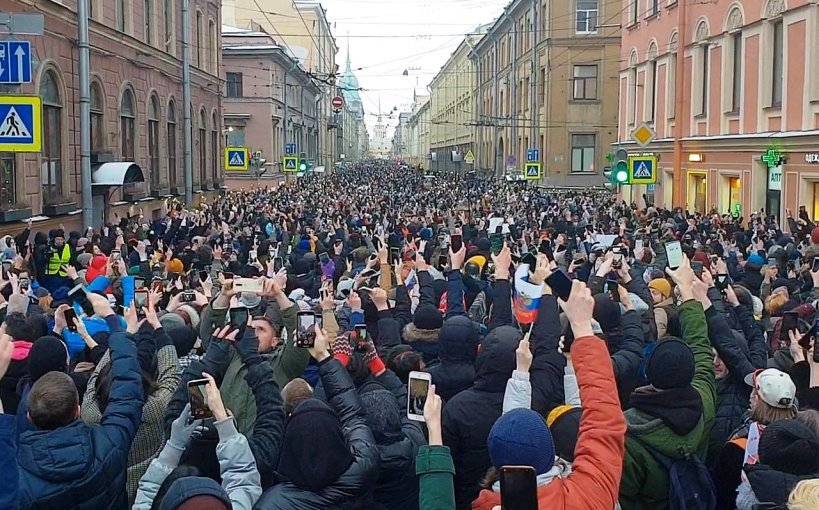
(PONARS Eurasia Policy Memo) While much media attention has been paid to the question of what will happen to the opposition movement in Russia after the arrest and imprisonment of Alexei Navalny, there has been less focus on his ordinary supporters—the tens of thousands across the country who have gone out on the street to protest his detention. In an extensive crackdown that was unprecedented during the Putin regime, over 11,000 were arrested and charged during a series of nationwide protests in January/February 2021, with another 1,700 arrested in April. Most were charged with violating the prohibition on participating in unauthorized gatherings though some were also prosecuted criminally.
In this memo, I show that while many protesters are demobilized and frightened by their encounters with the police and legal system, others who experience the system for the first time turn their shock into knowledge acquisition, empowering them to more confidently advocate for their own rights and the rights of others after arrest and in court. With survey evidence suggesting that around one-third of the January 23 protesters in Moscow were first-timers, it is important to understand what happens to an average protester after arrest and speculate on what these encounters with the legal system might mean for future legal and political mobilization. I find that post-protest arrests and court processes have helped encourage the development of DIY [Do-It-Yourself] legal education and lawyering and that these knowledge-sharing activities, while still small-scale, have radiating effects.
Dissuading and Disciplining
The Russian state has long counted on the dissuasive powers of the security services to discourage would-be protesters. They have tried to do this using two main tactics: preventing people from assembling in the first place and punishing those who do. To prevent people from showing up, students and other state employees have been warned of consequences at their places of work and study, law enforcement agencies have engaged in “prophylactic talks” with potential protesters and opposition leaders, and have also arrested protest leaders before the events begin.
To punish protesters, the state has relied heavily on Article 20.2 of the Code of Administrative Violations (KOAP), which can be used to fine and/or administratively detain people who attend unauthorized demonstrations for anywhere from 10 to 30 days, depending on the nature of the offense. There are also additional violations in the KOAP that can be used against protesters, including Article 19.3 (failure to obey a lawful order of the police) and Article 20.6 (failure to obey requirements for prevention and control of emergency situations). The KOAP also holds parents responsible for their minor children who attend protests and punish parents who bring their minor children to demonstrations with up to 15 days in administrative detention. There has also been a move to fire those who signed up to protest from state jobs.
Occasionally, to send a more serious message to future protesters, the state has moved to criminally prosecute and sentence to long prison terms a seemingly random subset of ordinary citizens who participated, for example, in the Bolotnaya Square case and the 2019 Moscow protest cases, and is now doing so post-hoc, using facial recognition software to target protesters for later arrest. In addition, a Criminal Code statute, Article 212.1, criminalizes three or more violations of Article 20.2 and can be punished with anything from fines to prison time.
Despite these increasingly harsh measures, people have taken to the streets in several large protest waves over the past five years—in 2017 nationwide to protest corruption; in 2019 in Moscow to protest the failure to register independent candidates for local elections; in 2020 in Khabarovsk to protest the arrest of Vladivostok governor Sergei Furgal on decades-old criminal charges; and most recently in 2021 country-wide, to protest the detention and imprisonment of Alexei Navalny.
Though arrests, administrative fines, and criminal charges have been a prominent feature of each of these protest waves, the state response to the January/February 2021 protests was qualitatively different. Police were more violent, and arrests across the country were the highest in the post-Soviet period. During the following protest in April, the police toned down their response in Moscow, arresting only 60 protesters, but continued harshly repressive tactics in St. Petersburg and elsewhere. While we have a good sense of the magnitude of the arrests and police violence, there has been little English-language coverage of the aftermath, particularly for the average protester.
What Happens After an Arrest?
The first step for most protesters who are arrested is a long wait in the police transport van (avtozak). Unlike previous protest waves where demonstrators had been able to keep their phones to contact loved ones, report basic information on their whereabouts to the organization OVD-Info, and even to post selfies on social media, in the 2021 protests, police took cell phones away.
The next step is transportation to a police station for processing. Large numbers of arrests in recent protests have meant that many people were taken to stations far from the city center. While the Russian Criminal Code requires that detainees are able to access a lawyer and make a phone call within 3 hours of factual detention (not counting time in the police transport van), the Administrative Code is a bit murkier, requiring access to a lawyer after a violation is issued. Detention can last up to 48 hours for an administrative offense that is punishable by administrative arrest, which pertains to many parts of Article 20.2. For this reason, it is often advantageous for the police to detain people for administrative offenses even if they later decide to press criminal charges.
Police, of course, have no desire to have lawyers anywhere near police stations where they can interfere with the processing of citations and other paperwork. Lawyers can talk to detainees and document violations committed by the police, including using violence, forcing arrestees to give their fingerprints and take mugshots, pressuring them to sign admissions of guilt, or not giving them water, food, or bathroom breaks within the time required by law, all of which are common violations in these situations. Consequently, in larger cities, particularly Moscow and St. Petersburg, the police use an institutional innovation called the Fortress Plan (Plan Krepost’) to make sure that lawyers cannot access their clients at all.
The Fortress Plan allows individual police stations to seal themselves closed in the case of an imminent threat—no entry or exit allowed by anyone. While this is supposed to take place on a station-by-station basis depending on the level of local threat, during the past several years, the city’s police forces have decided to declare the Fortress Plan for all stations within the city. As a result, lawyers are completely unable to access protesters, even though the law requires that a lawyer be admitted upon the request of a detainee (KOAP Article 27.3(3)). Eventually, as their paperwork is processed, protesters are released from custody with an administrative violation citation and, in the time of coronavirus, an additional citation for violating coronavirus restrictions. Once charged and released from the police station, defendants go home to await their day in court.
Once summoned to court, defendants can attend and try to contest their charges, or the proceeding can go on without them, and the penalty will be issued in their absence. There is no representation required for an administrative case, nor does the state guarantee any, even though the Administrative Code is quasi-criminal in nature, envisioning punishments anywhere from fines to 30 days of administrative detention. The European Court of Human Rights, in fact, has repeatedly held that some of the punishments envisioned in the Administrative Code are criminal in nature and therefore require the same due process as a criminal case, but that is rarely what happens.
Court hearings on administrative violations are mostly brief, formal affairs. The case file consists of a police report, the administrative violation write-up, and occasionally some sort of photo or video evidence, often indeterminate. This formalistic process is unsurprising. Researchers, including myself, have found that the legal system in Russia is designed as a machine to process cases as quickly and efficiently as possible. This tendency has been on full display in the post-protest legal cases, where an investigation after the 2019 protests in Moscow revealed eight judicial decision templates used repeatedly by judges throughout Moscow over a seven-day period. My interviewees have also mentioned this regarding police reports, which occasionally have even duplicated spelling mistakes. All told, there is little likelihood of successfully contesting an administrative violation in court.
After the citation and fines are issued, a protester can appeal to a higher court within ten days. The court undertakes a de novo review of the case, though it cannot issue a more serious penalty than was issued by the lower court. This gives the protester the opportunity to introduce additional evidence and perhaps get a better outcome, though this rarely happens. Within six months from the appellate decision, presuming that they lose the case, the protester also has the option to appeal to the European Court of Human Rights. Though the process can take up to several years to work its way through the ECHR, Russia is obligated to pay any compensation that is ordered by the court, and it adds to precedent that can be used to hold Russia responsible for future violations of protester’s rights.
The Rise of DIY Legal Defenses
Because administrative offenses have historically been non-political in nature, there is a provision in the Administrative Code (25.5(2)) that allows an “interested party” without any legal education or certification to represent a defendant in court.[1] This has led to the emergence of a small but powerful movement to undertake and promote DIY legal defense in Russia. Recognizing that administrative cases are not particularly lucrative or of interest to most lawyers and that mass protest detentions require a sudden surge of lawyer availability which cannot be met by the existing network of human rights lawyers, many organizations have started working to provide education on the processes and procedures of the court.
In addition to having no law that prevents this form of engagement, Russia’s adherence to the civil law tradition actually enables it. Often referred to as code-based law, Russia’s civil law-based legal system does not rely on precedent, technically treating each case as independent of all other cases. Thus, to be a DIY lawyer only requires that you gain knowledge of the specific code provisions that apply to your case and a little on-the-ground know-how from people who have navigated the system. This is what existing educational programs seek to provide.
The most prominent of these programs, beginning in 2016 as a collaborative project between the NGO Russia Behind Bars, the Sakharov Center, and OVD-Info, is the School for Citizen Legal Advocates (Shkola obshchestvennogo zashchitnika). The School helps people learn how to engage in DIY legal advocacy in both criminal and administrative cases through a series of lectures from lawyers combined with practical advice on what and what not to do. The School has educated over 2,000 people nationwide, with a concentration in Moscow and St. Petersburg. Other would-be DIY lawyers have found the online resource of Oleg Beznisko, who has created a series of instructional videos about how to defend oneself or others in an administrative case, from hearing, to appeal all the way to the ECHR. OVD-Info and other organizations have produced detailed guides on defending against administrative violations in court. Independent news organizations like Meduza have also published similar informational articles, including how to get compensation from the ECHR. In other words, for those who are motivated and interested, there is no shortage of information on how to engage with the system without a lawyer either to represent yourself or others.
The Goals of DIY Lawyers
Under Russia’s conditions, success is relative, and expectations are low. Most DIY lawyers consider their job, first and foremost, to provide moral support, guidance, and basic information about what to expect in the process to the defendants they are working with. They explain to the defendant that they are likely to lose and contextualize the fact that the injustice the defendant is about to experience is not an aberration but a feature of the system. At the same time, they offer hope with the possibility of eventual vindication (morally and financially) if the defendant is willing to go through the process of appealing the verdict to the ECHR.
“Success” then becomes a secondary goal and, in this context, a very limited one. Here, success generally consists of pushing back against the state by gumming up the works of the legal machine, making motions that prolong the trial, and slow down the efficiency of the process. For example, a defendant or their representative can make a motion that the officer who wrote the police report appears, which sometimes is granted. They can also ask that a prosecutor appear to uphold the state’s charges based on the fact that the ECHR has ruled administrative hearings to be quasi-criminal in nature and due process requires it. This motion is almost never granted by the court. With extraordinarily high caseloads and judges being evaluated based on efficiently processing those caseloads, these are small yet meaningful weapons that citizens can use against the state.
In terms of outcomes, success is rarely the dismissal of charges, though that may happen occasionally. Instead, success is getting a lower fine or punishment than was originally sought or expected, raising enough procedural objections such that the case is sent back to the police, where it may “disappear,” or getting the offense re-classified to one carrying a lesser punishment. In obtaining these outcomes, knowledge of the law and procedures is critical. In a system of heavy documentation, as the Russian legal bureaucracy is, the fight is all about whether proper procedures were followed, identifying technical errors in the case file (missing signatures, inconsistencies between documents, incorrect timestamps, etc.). In other words, with knowledge of what to look for, DIY lawyers can fight bureaucracy with bureaucracy and catch out police who tried to take shortcuts to speed processing and efficiency, for example, by having one officer’s name on the pre-filled form but having someone else sign it.
Conclusion and Looking Forward
While the power of these initiatives should not be overstated—they are still quite localized to the major Russian cities—the move toward DIY lawyering and rights education empowers individuals and may give them the confidence to engage in protest with less fear and interact with the police with greater knowledge of their legal rights. My early research suggests that this is happening. After the 2021 Navalny protests, interest in the School for Citizen Legal Advocates soared. Upon announcing a new session focused on detention and administrative violations, they received nearly 200 applications from across Russia in 24 hours for 60 slots. Most striking was that many participants in the School were not already activists but instead were catalyzed by their personal experiences of arrest and detention. They recognized that they did not know their rights and how to defend themselves against police indifference and misconduct and expressed a desire to be more prepared to help themselves and their friends in the future.
These knowledge-sharing activities are intended to have radiating effects. And they do. Many participants mentioned that they encountered someone in their detention location who had more knowledge of the law than they did and that they noticed those people were more confident and sometimes even treated differently. And while this is a small movement, this type of knowledge sharing increases the ability to hold the state and its legal system accountable. If one person in a group of 20 detainees is educated about how to document police misconduct and push back against violations of their rights, they can communicate that to everyone. Of course, this does not mean that the police will respect those rights—and we know of many cases from the most recent protest wave where they have not. As protests continue to be one of the main forms of political expression in Russia, seeing how protesters navigate post-protest detentions and punishments gives important insight into how ordinary people come to learn about the inner workings of the state and its justice system and how they might use that knowledge in the future.
Lauren A. McCarthy is Associate Professor of Legal Studies and Political Science at the University of Massachusetts Amherst.
[1] A similar provision applies to criminal cases (Criminal Code Article 49.2), however the “interested party” must receive the permission of a judge to participate and must work alongside a lawyer.