
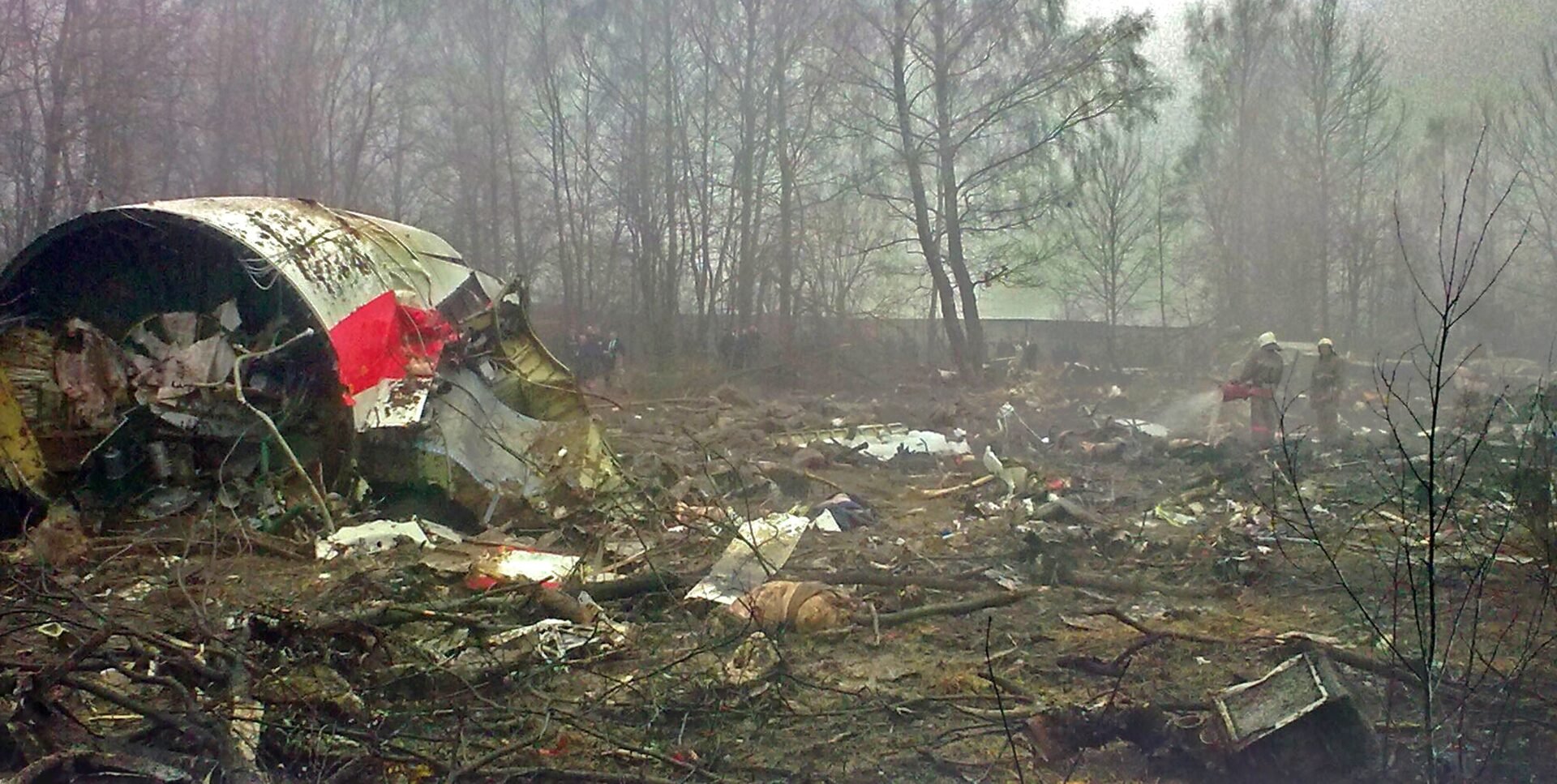
In Russia, politicians who run afoul of President Vladimir Putin are at risk of being killed by poison, defenestration, or gunshot, or of being sentenced to harsh prison terms on spurious charges. And now, in the wake of the airplane crash that occurred in the Tver region northwest of Moscow on August 23, many observers both inside and outside Russia believe the Russian president has come up with another technique for eliminating his rivals. No one doubts Putin’s ruthlessness, but whether he was in fact responsible for the downing of the plane is as yet unclear. The widespread assumption that Putin was behind it is politically important, but the full truth of the matter may never emerge.
Precedents from Abroad and at Home
On many occasions in the past, aircraft have become entangled in political shenanigans in various countries, especially in repressive dictatorships. When Argentina was under military rule from 1976 to 1983, the junta deployed military aircraft with special flight crews who would shove political prisoners to their deaths in the ocean. Dozens, perhaps hundreds, of detainees were killed in this manner. Even earlier, in 1971, a high-ranking Chinese Communist official, Lin Biao, died in a mysterious plane crash after China’s supreme leader, Mao Zedong, suddenly turned against him. Despite the passage of 52 years, many aspects of the Lin Biao affair remain inscrutable. Neither Mao nor his successors ever offered a thorough accounting of the matter. China’s current leader, Xi Jinping, like all his predecessors, has stuck to the outlandish claims that were put forth five decades ago.
Even when a plane crash involving a democratic country occurs and is known to have stemmed from pilot error rather than a grand conspiracy, political controversy can swirl around the incident. This was evident with the tragic crash near Smolensk in April 2010 that killed all 96 people on board, including Polish President Lech Kaczyński and other high-ranking Polish political and military officials. Polish investigators promptly undertook a thorough, transparent investigation that eventually pinpointed the cause as pilot error in severe weather, coupled with deficiencies on the part of the ground controllers. The weather around Smolensk was so inclement on the day of the crash that the pilot and ground controllers had warned against trying to make a landing, but they were overruled by senior figures on the plane, as was clearly revealed on the cockpit voice recorder. Even though the report from the Polish investigation was professional and highly convincing, it was denounced by Kaczyński’s twin brother, Jarosław, the long-time leader of Poland’s Law and Justice Party, who had previously been prime minister. He refused to accept the results and alleged, without evidence, that the crash was the result of a Kremlin-orchestrated conspiracy. He accused the Polish government, which was then under the control of the rival Civic Platform party, of covering up the matter on behalf of the Russian authorities. These baseless allegations continue to roil Polish politics to this day.
In Russia itself, an air crash in April 2002 became ensnared in political controversy, albeit only briefly. General Aleksandr Lebed, who had been a charismatic Russian army commander and then was elected governor of Russia’s Krasnoyarsk region in 1999, died when his official helicopter crashed into a high-voltage line in dense fog. A member of the Russian parliament, Aleksei Arbatov, initially speculated that sabotage might have played a role in the crash, but no evidence of that ever emerged, and Lebed’s family accepted the finding that pilot error in adverse weather was the cause.
The Prigozhin Crash
These and other earlier episodes should be borne in mind when assessing what we are likely to learn about the death of Evgenii Prigozhin, the controversial head of the so-called Wagner Group, a large collective of mercenary Russian soldiers who have perpetrated violent mayhem and atrocities around the world on behalf of the Russian Federation. On June 23-24, Prigozhin led some of his forces in a short-lived mutiny against Russia’s Ministry of Defense. Putin was apparently caught off guard by the mutiny and was slow to respond. As Prigozhin’s troops edged closer to Moscow, Putin angrily accused them of “treason,” but he did not follow up with a forceful crackdown. Instead, he accepted a murky deal that allowed Prigozhin and his soldiers to go free in return for ending the mutiny.
Many aspects of the mutiny and the subsequent “deal” did not add up, and most observers assumed that the whole affair would eventually end badly for Prigozhin. But just five days after the mutiny ended, Putin met in the Kremlin with Prigozhin and other senior Wagner Group personnel. By all indications, Prigozhin in recent weeks was able to travel around Russia and abroad with few constraints and to continue overseeing the intricate network of businesses he operated. Last month, for example, several of his companies signed lucrative new catering contracts with Russian government agencies.
But the crash of an Embraer Legacy 600 jet in Russia’s Tver region on August 23, with seven passengers and three crew members on board, brought a violent end to Prigozhin’s audacious career. He and his chief military commander, Dmitrii Utkin, as well as other senior Wagner Group figures, were among the passengers. On August 27, official investigators in Russia announced that DNA testing had confirmed the deaths of Prigozhin and others on the flight manifest.
Possible Causes
A great deal of speculation has arisen about the possible cause of the incident. Embraer Legacy 600s are extremely reliable and easy-to-fly aircraft and have had only one mishap in 20 years of service. Hence, there is little reason to believe that a technical glitch brought the plane down. Video footage posted online needs to be treated cautiously, but multiple clips show the same basic thing: namely, that the Embraer plummeted to the ground after what appears to be white smoke streamed from the plane.
Some Russian military bloggers claimed that an air defense missile struck the plane (perhaps after a ground controller misidentified the Embraer as a Ukrainian drone), but close analysis of the video footage does not show a missile or other external object that might have struck the plane and caused it to plunge.
A more plausible explanation is that an explosion occurred on board. If that is the case, one possibility is that the plane was carrying a crate of ammunition that accidentally exploded. This scenario has not really come up in discussions of Prigozhin’s fate, but if investigators are allowed to do their work properly, they will be able to find out whether the plane was brought down by an accidental detonation of ordnance. Whether anyone inside or outside Russia will believe the findings is a different matter.
Another, much more dramatic, possibility is that the plane was sabotaged with hidden explosives. Prigozhin had many enemies who would have been pleased to see him dead, but access to the plane was severely restricted, and multiple inspections were conducted before the flight (contrary to initial rumors that the plane had been left unguarded). Some observers in Russia have alleged that Artem Stepanov, a former pilot who once ran the company that serviced the Embraer, may have been the culprit, but there is no convincing evidence that he was anywhere near the plane on August 23 or had any involvement in the incident.
If sabotage did occur, it is highly unlikely that whoever planted explosives on the Embraer was acting as a freelancer. The saboteur would almost certainly have been enlisted by an authoritative, top-level figure. Russian Defense Minister Sergei Shoigu and the chief of the Russian General Staff, Valerii Gerasimov, were repeatedly berated and ridiculed by Prigozhin over the past year, and the two of them have shed no tears over Prigozhin’s death. But it is doubtful that either of them would have acted against Prigozhin without Putin’s explicit approval.
Long after news of the crash emerged, Putin himself eschewed any comment, perhaps because he was trying to gauge precisely what had happened. On the evening of August 24, he finally broke his silence, saying he was “dismayed” by the “tragedy” and expressing “sincere condolences to the families of all who perished.” He praised Prigozhin as “a talented man and a talented business executive” whom he had known since the early 1990s, and he hailed Prigozhin’s Wagner Group for having made a “fundamental contribution to our common cause of battling against the neo-Nazi regime in Ukraine”—a contribution “we will never forget.” Putin acknowledged that Prigozhin was “a man of a complicated fate who made serious mistakes in his life,” but he emphasized that Prigozhin had been able to “achieve the necessary results both for himself and, when I requested it, for our common cause, including in recent months” in Ukraine.
During Putin’s 24 years in power, he has often resorted to assassinations and extralegal violence to reinforce his control of Russian politics, and it is therefore not surprising that most Russian and Western observers have assumed that he orchestrated Prigozhin’s death as revenge for the mutiny in June. Such an assumption would ordinarily be reasonable, but in this particular case it may be premature. Putin’s somber tone during his televised remarks about Prigozhin did not give the impression of a leader savoring the death of a vanquished rival. Even though Putin did not attend Prigozhin’s funeral on August 29, that was apparently because Prigozhin’s family wanted to keep it a private matter.
The Elusive Truth
Whatever the case may be, the truth about Prigozhin’s fate—whether accidental or instigated by those who wished to do him in—will probably never be known. Putin promised that an investigation “will be conducted in full and brought to a conclusion. There is no doubt about that.” Actually, there is every reason to doubt it. The Russian government’s swift rejection of help from Embraer, the Brazilian manufacturer, which had offered to send experts to assist with the investigation, was hardly an encouraging sign. Even if a thorough investigation is eventually conducted, the odds are that it will ultimately lead nowhere. Accurate details of the plane crash may well be disclosed, but there is little reason to believe that the investigators will reveal who ordered the sabotage of the plane (if that is indeed what caused the crash).
Instead, what will likely unfold is a blither of lies and cover-ups, as has happened in Russia in the wake of many high-profile assassinations, such as the murder of the opposition leader Boris Nemtsov in February 2015. The general pattern in Russia on such occasions has been that investigations are carried out, but no convincing explanations are ever offered and no high-level figures are ever held to account. This lack of accountability at high levels is common in autocratic countries. The Argentine junta’s use of aircraft to get rid of political opponents did not come to light until well after the military rulers were dislodged from power, giving way to a democratic government. China’s Communist rulers have never come clean about the Lin Biao affair half a century ago and instead have dismissed it as “old business.” There is no reason to believe that Russia’s autocratic government under Putin will be any more forthcoming about the circumstances that led to the crash of Prigozhin’s plane.
Mark Kramer is Director of Cold War Studies at Harvard University and a Senior Fellow of Harvard’s Davis Center for Russian and Eurasian Studies. This memo was completed in August 2023.


