(PONARS Eurasia Commentary) Dinissa Duvanova, Pauline Jones, Eric McGlinchey, Yulia Nikitina, and Mariya Omelicheva provide insight into the recent, disconcerting events in Kazakhstan.
GazMaidan, Crimea #2, or End of the Old Man’s Clan?
Dinissa Duvanova, Associate Professor, Lehigh University
On January 5, bitcoin dropped by 13 percent in a single day. One of the big players in cryptocurrency mining, Kazakhstan, was shaken by mass protests, Internet outages, travel disruptions, looting, and the burning of government buildings. The leaderless revolution went “off-line,” and by the morning of January 6, it was crushed by peacekeepers from the Collective Security Treaty Organization (CSTO) using automatic weapons and armored military vehicles.
Kazakhstan has not witnessed a protest of such magnitude in its recent history. Sparked by local economic demands, it quickly escalated into a mass anti-government action against President Kassym-Zhomart Tokayev and his predecessor Nursultan Nazarbayev, who, after resigning the presidential post in 2019, was widely believed to informally control the country.
The protests started on January 2 in the western city of Zhanaozen over a two-fold increase in the price of liquefied petroleum gas (LPG) that followed its price liberalization. The site of a deadly 2011 riot, Zhanaozen is located in the country’s remote oil-rich region, where the locally produced LPG is the primary fuel. Security forces brutally suppressed the 2011 Zhanaozen protests, but this time protestors were able to coordinate roadblocks to stop troops and security reinforcements reaching the city. On January 4, authorities announced a gas price drop for the province, but this did not deescalate the situation.
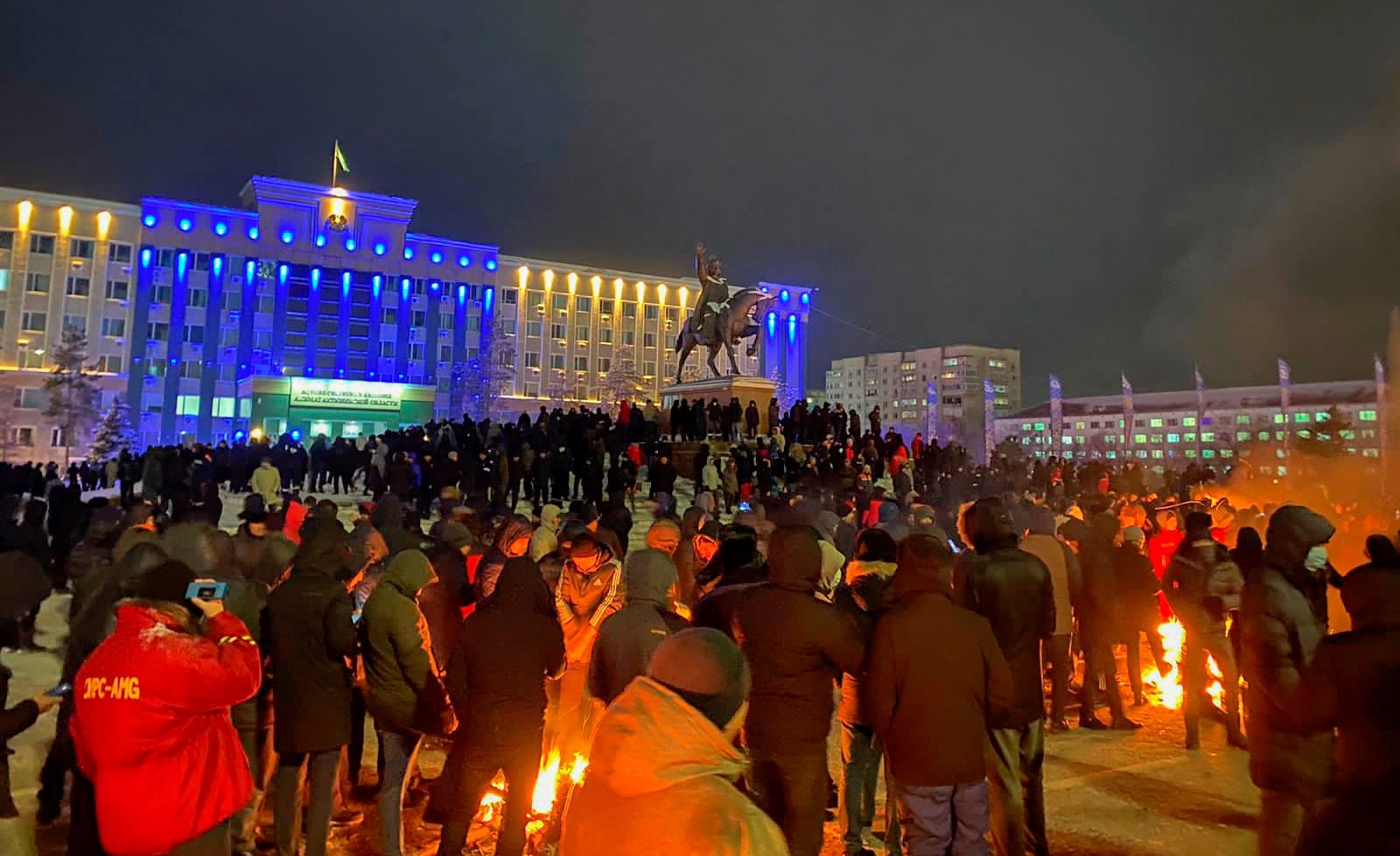
Instead, the protests spread to 14 major cities throughout the country. By the end of the day on January 4, peaceful protests turned into violent clashes with the police in western Kazakhstan and in the country’s largest city of Almaty. Law enforcement officers began to use stun grenades and tear gas. Thousands of protestors shouted “Shal ket,” “Old man, out,” toppled Nazarbayev’s statues, and burnt cars. On the morning of January 5, Tokayev dismissed the government, extended the energy price controls to the rest of the country, and declared a state of emergency.
Despite this, Almaty protestors stormed and captured City Hall, police headquarters, and the procurator general’s office. The offices of three national television stations were seized and vandalized. When rumors spread that the wealthy elites and high state officials were planning to flee the country, a mob marched to the Almaty airport, looted the building, and seized airplanes. Another mob used bulldozers to break into banks, constructed barricades, and, according to videos circulated on Instagram, distribute weapons. In the western city of Atyrau, police fired on demonstrators with deadly force. The Ministry of Internal Affairs reported eight security personnel dead and over 300 injured on January 5. Citizens report numerous casualties on the protestors’ side, but official numbers have not been reported.
In a televised address, Tokayev declared the country was attacked by “international terrorist gangs, who trained abroad,” and called for CSTO security assistance. Many Kazakhs saw Tokayev’s appeal to the CSTO as an invitation of military occupation by Russia, a country with an established record of supporting undemocratic leaders abroad and carrying out military interventions in bordering countries. Russian CSTO peacekeepers arrived within hours of the televised address and established a firm presence in Almaty. On January 7, Tokayev issued a “shoot to kill” order against protestors, and the Kazakh Interior Ministry reported over 3,000 arrested, 26 (armed) civilians killed, and 18 injured.
Labeling protestors as international terrorists was necessary to justify the use of military force against civilians and the subsequent repressions. At the same time, the circumstances in which the protests spread and the tactics of the protestors suggest the presence of resourceful, yet unknown, leaders. The rapid spread of protests coincided with Internet and mobile telephone outages, which makes spontaneous organization across the country’s vast distances quite unlikely. The repertoire of protest activities is radically different from anything experienced in Kazakhstan since its independence in 1991. Kazakh protestors never before burnt government buildings or stormed the offices of the procurator general. Most suspicious is that while the mob seized many law enforcement buildings, they avoided the prison holding the activists detained on January 4.
With the suspension of the Internet and mobile networks, there is an information blockade, and it is hard to make sense of the rapidly unraveling events. At least three plausible interpretations of the events have emerged.
1. The Protests were instigated by foreign interests.
Outside of Kazakhstan, specifically in Russia, Tokayev’s references to foreign-trained terrorists largely refer to the West. In Kazakhstan, however, they first invoked the exiled opposition leader Mukhtar Ablyazov, who admits his Democratic Choice of Kazakhstan party is behind at least some of the protests. Others in Kazakhstan believe that looting and violence were instigated by Russia’s agents to provoke the CSTO’s involvement and were part of Russia’s cunning plan to reenact Crimea’s “reunification” scenario in Kazakhstan’s northern provinces, which during the Soviet times were administratively transferred to the Kazakh Soviet Republic.
The following two interpretations are cast in terms of internal power struggles.
2. Tokayev grabbed control over the security agencies and economic assets controlled by Nazarbayev’s clan.
By eradicating competitive elections and legitimate political opposition, Nazarbayev’s regime made violence the only available mechanism of political change. The January 5 protests are strikingly similar to the late Soviet protest in Almaty against the Moscow-appointed Communist Party Chairman Gennadiy Kolbin. Back in 1986, the country was terrified by mass protests and brutal suppression by the Soviet army. Many believed those protests were instigated by the Republican leadership to discredit Moscow’s appointee and replace him with a local leader: Chairman of the Republican Council of Ministers, Nursultan Nazarbayev.
Similarly, the current protests might have been window dressing for an intra-regime coup against Nazarbayev’s clan. Tokayev’s dismissals of Nazarbayev from the position of Chairman of the Security Council and Karim Masimov as head of the National Security Committee (formerly KGB) support the power-grabbing explanation. Social media rumors say Nazanrbayev is dead, but Telegram channel Orda.kz reported that Nazarbayev fled the country. His absence from the scene is highly suspicious. Rumors are reinforced by past regime propaganda that portrayed Nazarbayev as the guarantor of stability. The unspoken implication of that guarantee was that without Nazarbayev, there would be bloodshed.
3. Oligarchs from Nazarbayev’s close family circle, Kairat Satubaldyuly and Timur Kulibayev, attempted to remove Tokayev.
There are those who believe Tokayev was on the offensive. The hijacking of peaceful Almaty protests by violent armed gangs and reports of Islamist-style beheadings of captured policemen prompted speculations about the involvement of Nazarbayev’s inner circle.
In 2019, Kairat Satybaldyuly, a known Wahhabi sympathizer, billionaire, and Nazarbayev’s nephew, attempted to organize an Islamic political party, but it was blocked by the authorities. Kairat is a large shareholder in the telecommunication infrastructure. He is also a brother of Samat Abish Satybaldyuly, the first deputy chairman of Kazakhstan National Bank, and who was dismissed by Tokayev on January 5 and imprisoned on January 7. They are the most powerful figures of the southern Uly Zhus tribal clan, and many believe they were groomed by Nazarbayev as potential successors.
The LPG price hike also leads to Nazarbayev’s inner circle. Domestic observers have called the LPG prices a reckless decision on the part of the Energy Ministry and the industry association headed by Nazarbayev’s son-in-law Timur Kulibayev. In 2011, Kulibayev’s dismissal as the head of the Samruk-Kazyna State Holding, which controls the country’s largest companies and about 40 percent of the national economy, was considered punishment for his mishandling of the Mangystau oil workers’ protests. Today, Kulibayev’s control extends over the oil and gas sector. If Kulibayev orchestrated “GazMaidan” to gain political capital, he might have miscalculated Tokayev’s willingness to call upon Russian military help in crushing the clan war. We might never know whether the price spike was an epic blunder or a carefully calculated move by an aspiring clan leader.
Regardless of elite power struggles, economic grievances, staggering inequality, and widespread corruption remain the major sources of anti-government sentiment. The global pandemic had exacerbated the plight of millions of ordinary Kazakhs, whose livelihood depends on the trickling down of wealth from large private and quasi-governmental companies and state officials. With the volatile oil prices, staggering capital flight, and continuing dependence on the Russian market, Kazakhstan is on the brink of social revolution. Deployment of the CSTO peacekeepers might have restored the order, but it had also put a national-patriotic coat on the socio-economic grievances. Tokayev has betrayed the country’s sovereignty and Russians sunk in blood Kazakh protests against the corrupt dictatorship. This is how Kazakhs will remember the events of January 2022.
What is next? Kazakhs’ worst fear of Russia’s annexation of Kazakhstan might seem quite real today. The outright annexation of a landlocked country with a per capita GDP below Russia’s level, however, does not seem a particularly promising move. Yes, the presence of Russian troops in Kazakhstan can boost Moscow’s domestic and international standing. Tokayev’s regime survival now depends on Russia, which will further reinforce his loyalty to President Vladimir Putin. Future incitement of anti-Russian sentiment in Kazakhstan may become yet another target of the Kremlin’s chauvinistic propaganda.
Nazarbayev’s Second Exit: A Legacy of Disgrace
Pauline Jones, Professor, University of Michigan
Nursultan Nazarbayev, Kazakhstan’s first post-Soviet president who held that position for almost thirty years (1991-2019), has made a second exit from power.
The first was graceful. Rather than running for a sixth term in 2020, on March 19, 2019, Nazarbayev resigned and anointed then-Chairman of the Senate Kassym-Jomart Tokayev as his successor and stepped aside as snap elections were held in June 2019. It was seemingly well-timed if the goal was to preserve his legacy. Nazarbayev built his reputation on the perceived success of his model of development, which was predicated on stability and prosperity via economic liberalization and soft authoritarianism. To be fair, he is responsible for the significant progress that oil-rich Kazakhstan has made in transitioning to a market economy. But these gains peaked in the mid-2010s. Since roughly 2016, the economic situation in the country has continued to stagnate due to low oil prices, corruption, and constraints on the growth of the private sector. Not unrelated, Kazakhstan has also experienced increased popular discontent and political mobilization, forcing the government to utilize its sovereign wealth fund to both support the economy and increase social spending.
Nazarbayev’s first exit was also incomplete. He was declared “Elbasy” (“leader of the nation”) in 2010, which signaled that he would both maintain a role in determining Kazakhstan’s future trajectory and remain immune from prosecution. Nazarbayev’s continued influence over the country was secured when, following Tokayev’s successful election to the presidency, Nazarbayev was named lifelong chairman of the National Security Council and leader of the ruling Nur Otan political party. More honorifically, the capital city was renamed Nur-Sultan.
Nazarbayev’s second exit is nothing like the first. It is dishonorable, ill-timed, and complete. It also leaves a legacy in disgrace.
Nazarbayev was forced out in the wake of the mass protests that have swept Kazakhstan since January 2, 2022. Although these protests began in response to a steep rise in fuel prices, they quickly escalated from economic grievances to political demands. Foremost among these demands was for the regime to finally distance itself from Nazarbayev. In Atyrau, where the protests began, protestors reportedly yelled “Shal Ket” (“Down with the Old Man”) in reference to him, which has become a common slogan. Just outside Almaty, the country’s largest city, protestors worked to topple Nazarbayev’s statue. Tokayev responded by not only dismissing Nazarbayev from his position as Chairman of the National Security Council but also removing Nazarbayev’s political allies from the security services and replacing them with his own.
Although these actions did not quell protests, they sent a strong signal that Nazarbayev is being held accountable for Tokayev’s failure to implement needed and promised reforms. They have thus also changed the meaning of Nazarbayev’s legacy. Now, rather than being held up as the Elbasy and remembered for securing Kazakhstan’s stability and prosperity, he will likely be equated with its fragility. More so, given Tokayev’s choice to repress protestors and invite foreign intervention to prop up his regime, Nazarbayev’s second exit will also be associated with the country’s violent turn.
Succession and Legitimacy Issues
Eric McGlinchey, Associate Professor, George Mason University
The protests in Kazakhstan underscore two enduring challenges of Central Asian authoritarian capacity and stability: (1) the challenge of autocratic succession and (2) the challenge of popular legitimacy. Kazakh President Kassym-Zhomart Tokayev’s tenure has been plagued by his predecessor Nursultan Nazarbayev’s unwillingness to relinquish power. Even after Tokayev ascended to the presidency, Nazarbayev maintained considerable albeit opaque power as the head of Kazakhstan’s Security Council. Such tandems can remain stable as long as both leaders appear robust. When leaders like Nazarbayev, now 81 and in declining health, falter, scrambles for power become increasingly likely. It remains unclear to what extent competing elite efforts of power-grabbing are behind Kazakhstan’s current unrest. What is clear, though, is that Tokayev capitalized on this unrest to consolidate his own authority and dislodge Nazarbayev and his followers from state institutions of power.
Even with Nazarbayev sidelined, Tokayev’s ability to hold power is far from certain. Tokayev faced no real opposition in the snap elections that delivered him the presidency in 2019. And while it is understood that the current protestors’ slogan, “Old man, go away,” is in reference to Nazarbayev, there are no accompanying chants demanding that Tokayev stay. Elsewhere in Central Asia, this absence of legitimacy is less of a problem. The Uzbek and Turkmen presidents had the good fortune of assuming office after their predecessors had died. Uzbek President Mirziyoyev and Turkmen President Berdymukhamedov were thus able to take hold of their states’ ruling parties and thereby perpetuate patronage politics as normal. With Nazarbayev still alive yet now stripped of office, Tokayev will be hard-pressed to effect a similar consolidation of authority in Kazakhstan.
If not the autocratic stability of Uzbekistan or Turkmenistan, what then is the political future of Kazakhstan? Here neighboring Kyrgyzstan holds insight. Should Kazakhstan see continued elite fragmentation, presidential turnover will be frequent. This turnover can happen both through the ballot box and through widespread protests. Democracy may not be in Kazakhstan’s immediate future. Critically though, the current and, lamentably, deadly political rupture unfolding in Kazakhstan has opened a window through which Kazakh democracy can be envisioned.
The Collective Security Treaty Organization (CSTO)
Yulia Nikitina, Associate Professor, Moscow State University of International Relations (MGIMO)
Articles and commentaries in the Western media that Russian troops, or troops from the “Moscow-led” Collective Security Treaty Organization (CSTO), departed to Kazakhstan created the sense that Russia might use the opportunity to play an important role in the political turmoil to gain more influence in Kazakhstan. I do not think this should be the primary interpretation of events. The history of CSTO activities gives a wider perspective on the deployment of its peacekeeping forces.
To begin with, this is the first time in history that CSTO troops have been deployed for a real operation. In previous cases such as in Kyrgyzstan in 2010, Kazakhstan in 2011 (in Zhanaozen, the same region where the turmoil started this time), and in Tajikistan in 2012 (putting aside events in Armenia in 2018 and in Belarus in 2020), the CSTO was not involved and never wanted to be. Without a formal request from a member state, the CSTO does not have the legal authority to act. Previously, member states avoided calling on the CSTO in order not to create precedents of interference in domestic affairs.
Second, the CSTO has three types of collective forces: Collective Operative Reaction Forces (around 20,000 troops trained to counter terrorists and extremists), Collective Rapid Deployment Forces (5,000 troops trained to counter threats from the territory of Afghanistan), and Collective Peacekeeping Forces (about 3,500 troops). Out of the three, the peacekeepers were enacted, as they are perceived to be more neutral by the Kazakhstani population. Their tasks are not to participate in what the Kazakhstani government calls “anti-terrorist operations” but to assure the security of military sites such as Baykonur and anti-ballistic missile sites.
Third, all members of the CSTO send peacekeepers, not only Russia. All CSTO collective forces have been trained for years to react rapidly and deploy in days, if not hours. Russian troops are better trained to deploy rapidly in comparison to other CSTO members, so they were the first ones to arrive in Kazakhstan.
Four, President Kassym-Zhomart Tokayev’s claim that the protests were externally-inspired might be partially explained by the legal side of cooperation within the CSTO. The organization was created to react to external threats (mostly from Afghanistan), and all of its legal documents are framed accordingly. However, changes to the CSTO Charter in 2010 allowed the organization to react to domestic turmoil if it threatens national sovereignty. Chapter 8 of the CSTO Charter outlines a response system to crisis situations that endanger the security, stability, territorial integrity, and sovereignty of member states. The current turmoil is certainly such a case of crisis management. However, the decision of the CSTO to send peacekeepers was taken on the basis of the Collective Security Treaty, which still restricts collective action to respond to external threats. By stressing the external nature of the threat, Tokayev, on the one hand, creates a legal basis for addressing the CSTO. On the other hand, he may try to avoid creating precedents of the CSTO’s potential future involvement in purely domestic unrest.
Events are still developing. The turmoil does not seem to be geopolitical yet, even while the media discusses the geopolitical dimensions, which may lead to a self-fulfilling prophecy, especially in the context of increased Russia-West tensions.

The Broader Implications of the Turmoil
Mariya Omelicheva, Professor of Strategy, National War College, National Defense University
The countrywide uprising in Kazakhstan has shattered its image as an “oasis of stability” in a sea of political turmoil. The events on the ground are still unfolding, and it will take time to piece together the confluence of socio-economic and political causes for the mass protests. As we decipher what happened and why, it is also important to consider the broader implications of unrest in Kazakhstan.
First, the political undercurrents of the uprising, triggered by concerns about rising gas prices, signal the frailty of Kazakhstan’s model of political succession, which is eyed by the governments of Russia and Belarus. The “anointed” successor to Nursultan Nazarbayev, Kassym-Zhomart Tokayev, has operated in the shadow of the first president. Whether the unrest is an expression of public dismay over corruption and economic stagnation linked to Nazarbayev’s rule or an effort by Tokayev to consolidate his power, footage of Nazarbayev monuments toppling and the storming of the presidential residence in Almaty is likely to remove the orchestrated political transition option for the Kremlin before the 2024 presidential elections.
Second, the uprising in Kazakhstan considerably reduces the likelihood of Russia’s full-scale invasion of Ukraine. Fresh on the minds of Kremlin protagonists are the widespread demonstrations in Russia sparked by the arrest and jailing of Alexei Navalny and fueled by poor socio-economic conditions and political corruption. The events in Kazakhstan shed light on the government’s decisions with a high potential for public discontent. A possibility of public unrest triggered by a costly military operation with dubious goals and devastating international consequences will give a pause to the Kremlin.
Third, Moscow’s swift dispatch of paratroopers to Kazakhstan under the auspices of the Collective Security Treaty Organization can be seen as a prelude to the Kremlin’s response to a similar set of circumstances at home. The Russian regime has developed a sophisticated coercive machine that can effectively quell public dissent but has avoided relying on lethal force to date. Kazakhstan can become a testing ground for a counter-revolution approach that combines a militarized response buttressed in a narrative conflating external and internal security threats.