Image credit/license
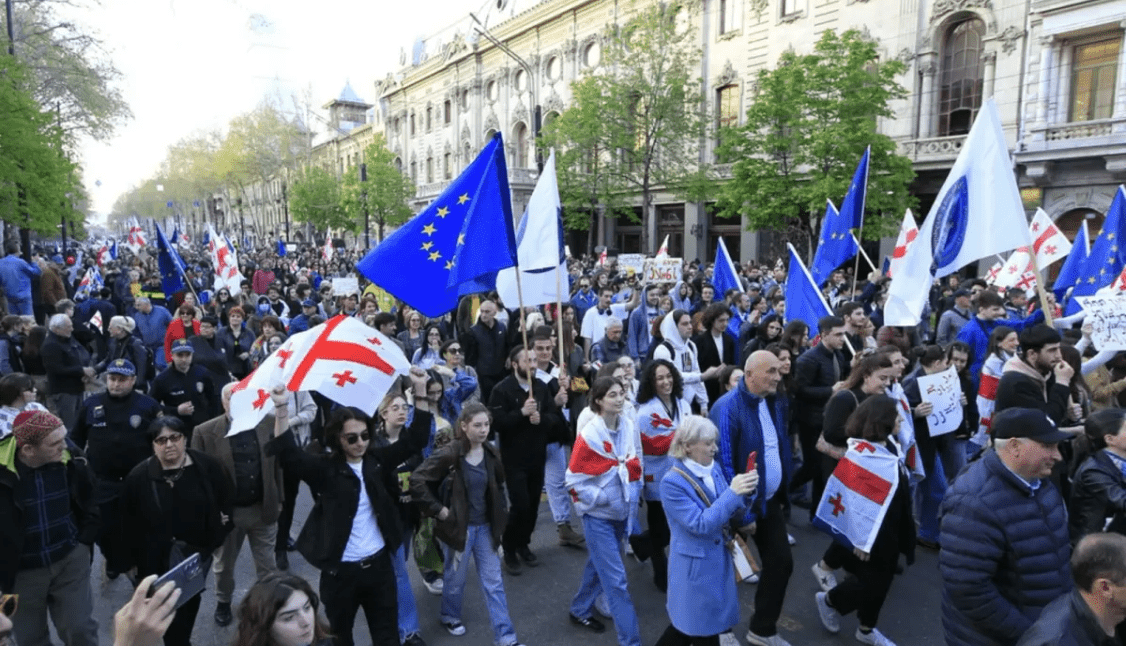
Geopolitics is perilous to democracy. This is the cautionary story from the recent adoption of “foreign agent” laws in Kyrgyzstan and Georgia (called “foreign representatives” by the former and “the transparency of foreign influence” by the latter). These highly controversial bills put the governments in Bishkek and Tbilisi in a difficult spot—especially Georgia, where massive protests ensued—which they would have preferred to avoid. Yet, because the bills became highly “geopoliticized,” they had no choice: It became less about regulating civic organizations and more about choosing whom to align with—Russia or the West. Notwithstanding notable differences in the debates around the laws in Kyrgyzstan and Georgia, their outcome was basically the same: Each government faced an essentially zero-sum dilemma, and the final decision favored the side that could bring the most pressure to bear on local decision-makers.
How the ‘Foreign Agent’ Laws Became Enmeshed in Geopolitics
The recent debates over the “foreign agent” bills in Kyrgyzstan and Georgia were defined by geopolitics: whether the country would align with Russia or not, with the latter assumed to mean alignment with the West. This is unsurprising given the recent increase in geopolitical tensions: Russia’s full-scale war in Ukraine, along with the prospect of a “new Cold War,” has made the question of alignment more real than ever for Russia’s neighbors. But whereas democracy was harnessed for geopolitical ends by the leading democratic powers during the Cold War, geopolitics today has not only strained established democracies at home but also jeopardized the democratic prospects of younger hopefuls. The “foreign agent” laws are a case in point.
Recall that opponents of the law in Georgia won a temporary reprieve in 2023—like those in Kyrgyzstan in 2016—when, facing intense protests, the Georgian parliament took the bill off the agenda. Having successfully branded it as the “Russian law,” opponents drew a sharp line between the country’s choices: the democratic European Union, which Georgia aspired to join, or the autocratic Russia, which had de facto annexed two Georgian regions in 2008 and was invading Ukraine. The victory, however, was short-lived: A year later, and shortly after Kyrgyzstan adopted its own “foreign agent” law, the Georgian parliament resurrected the bill. It remains unknown whether Georgian MPs were inspired by Kyrgyzstan’s example.
Whereas Georgia’s story was geopolitical from the start, Kyrgyzstan’s was not quite so. Without anything like EU membership in the air for Bishkek, and given its location in a region dominated by Russia—where the governments tend to align with Russia for lack of an alternative rather than by choice—there was a chance that a legislative initiative regulating domestic institutions might avoid setting off geopolitical land mines.
The year-long active battle over the bill began in April 2023, when Vyacheslav Volodin, the speaker of the Russian parliament, encouraged Kyrgyzstani MPs to borrow Russia’s experience in devising laws to “counter foreign interference,” especially “foreign NGOs, funded by the West, trying to dilute sovereignty, statehood.” A year later, days after the bill passed in its second hearing, Russia’s then-Defense Minister Sergei Shoigu said on record, in what sounded like a final push to get it over the finish line, that “more than 100 large NGOs” operated in Central Asia and that, against the backdrop of the war in Ukraine, they “have significantly increased their anti-Russian activities.” He emphasized that Russia was taking “preventive measures” against them.
Shoigu’s comments, made on February 27, 2024, came after U.S. Secretary of State Antony Blinken and Kyrgyzstani President Sadyr Japarov exchanged letters. In mid-January, it emerged that Blinken, in a letter to Japarov, had praised the traditionally robust civil society in Kyrgyzstan, raised concerns about the bill’s impact on its operations, and called on the president to reject the bill. Japarov responded in early February, with the news leaking similarly to that of Blinken’s letter, likening the bill to the 1938 U.S. Foreign Agents Registration Act and asking to “not interfere” in Kyrgyzstan’s internal affairs. Both letters, predictably, were much hyped in the Russian media, the first as worthy of condemnation and the second of praise.
It was the media where Russian efforts to push the bill through were focused, primarily by demonizing the West and NGOs. By early 2024, outlets such as Sputnik.kg and Stanradar.com, together with outfits such as the Russian International Affairs Council and the Kyrgyzstani informal, nongovernmental discussion forums Pikir and Oy Ordo, had been geared up to promote the bill. They were joined by various Kyrgyzstani government officials and politicians, in their personal and public capacities, who chimed in with similar messages.
Opposing the bill were civil society organizations that would be affected by its stifling regulations, along with a number of embassies and international organization offices in Bishkek, many international human rights groups, and independent media. While most of their arguments concerned the substance and likely consequences of the bill itself, it was their predominantly Western orientation that got the most attention. Tellingly, media and civil society opponents of the bill spent much effort revealing the Russian links of its authors and calling on Western embassies and governments to impose punitive measures on MPs who supported the bill.
Thus, with contributions from all the sides involved—Russian and Western officials, Kyrgyzstani civil society and media, and representatives of Kyrgyzstan’s parliament and government agencies—the issue came to be framed as a geopolitical choice.
The Consequences of ‘Geopoliticization’
As said above, Georgia’s case may have been unavoidably geopoliticized from the start. This seems logical given the brief war fought by the country against Russia in August 2008, as well as the EU candidate status granted to Tbilisi in December 2023. Moreover, the pro-Russian government of Georgia, under the leadership of Russian-made billionaire Bidzina Ivanishvili, faced weeks-long mass protests against the “Russian law.” Debating the substance of the bill was of secondary importance, and the few instances of such debate tended to accentuate the “Russian-ness” of the bill. The game was zero sum.
Kyrgyzstan’s “foreign agent” bill, on the other hand, was not burdened by geopolitics by default, and there was a possibility of its being debated as a domestic matter first and foremost—as an unnecessary, costly, and discriminatory regulatory measure. Once enmeshed in geopolitics, however, it turned into a zero-sum game, where the eventual choice was all too clear, since crossing Russia would be too costly. Rejecting the bill promised short-term benefits from the West at best; no large-scale, long-term benefits would have accrued to Kyrgyzstan, and civil society would have soon resumed its criticism of the government. Even so, on multiple occasions, Japarov alluded to interest in cooperation with the West, including in his response to Blinken and elsewhere.
In the end, the Kyrgyzstani “foreign agent” bill was amended, with harsh criminal liability provisions removed at the president’s behest—in partial recognition of the criticism—but was adopted nonetheless. The most active and vocal NGOs were left hanging, faced with a decision to cease operations, reregister as some different type of legal entity, or become “foreign representatives” and await the consequences of that designation.
The Kyrgyzstani government was fully vindicated in its choice. Moscow was pleased, and the West soon appeared to have put the issue behind. New major grant opportunities were announced—or those that had been planned previously were not retracted—by both the United States and the EU. After several years of delays, yet shortly after the “foreign agent” law was adopted, Kyrgyzstan signed an Enhanced Partnership and Cooperation Agreement with the EU. There was, overall, no particular cost incurred by Bishkek for going ahead with the bill; the critics had played a geopolitical game that they were bound to lose.
The international reaction to Georgia’s “foreign agent” law was mixed: For example, the country’s EU accession process was frozen, while other threats, especially from the United States, remained vague. Thus, ahead of the October 2024 parliamentary election, Ivanishvili’s Georgian Dream party looked to have won this battle and remained on the offensive, to the quiet satisfaction of Russia.
The Road Not (Quite) Taken
The alternative that did not transpire—especially in the case of Kyrgyzstan—was a proper national debate about the role a free civil society can play in the country, the extent and forms of necessary regulation of civic organizations, and, more broadly, the meaning and relevance of democracy in Kyrgyzstan and the institutional parameters of democratic governance that the country needs. Civil society organizations failed to invest sufficiently in strengthening their solidarity with the public at large and local communities in particular and explaining to them the harmfulness of the law for ordinary people. At the same time, only sparse efforts were made to engage substantively on the issue with the parliament and especially with the presidential administration and Japarov himself—the locus of decision-making.
Several incisive legal and regulatory impact analyses were carried out by Kyrgyzstani legal experts and think tanks, but for the most part, they were left by the wayside. They shed light on the glaring shortcomings and contradictions in the text of the bill, as well as its tangible consequences for all spheres in which NGOs operate in the country—the environment, children’s and women’s rights, education, health care and palliative care, the welfare of elderly people, labor migration issues, and human rights and civic freedoms. These issues were eclipsed, rarely receiving a proper public discussion.
Had the bill not become enmeshed in geopolitics, to the extent possible, democratic participation and debate itself would have been strengthened. In other words, Kyrgyzstan would have benefitted from an occasion of properly locally oriented civic debate and engagement—this is what was most at stake with this law. Mobilizing stronger arguments, building dense networks and platforms of engagement, recruiting broader public interest and voices, and, last but not least, finding acceptable and fair compromises and agreement with the country’s leadership—such aspects of democratic civic work would have been the gains of such a process.
Conclusion: ‘De-geopoliticize’ Democracy
Geopolitics imperils democracy. Whenever an otherwise debatable and negotiable issue turns into an object of geopolitical contestation, this narrows or eliminates the scope for any such debate or negotiation. Therefore, antidemocratic actors, such as Russia, have a vested interest in turning any issue into a geopolitical contest. Taking their bait and responding in kind is deleterious for the cause of democrats. Instead of a politics of participation and decision-making by reasoning and consent, what results is a politics of rallying, propaganda, and inflexible polarization of “us versus them” and “friend versus foe.”
The recent stories of Kyrgyzstan and Georgia, in their different but overlapping paths, are salutary. Neither state—not even Georgia, arguably, after the display of impressive popular activism—saw its democracy strengthened. In both states, what the larger spectatorships saw was mainly a fight between pro-Western and pro-Russian forces: one that pro-Western Georgians seemed close to winning but did not, and one that Kyrgyzstan’s Japarov, trying to stay unaligned, would rather have avoided but could not. For the average citizen, democracy was at best a term synonymous with the West, but not really an issue of genuine Georgian or Kyrgyzstani concern.
These cases should lead to new, broader, and deeper analyses of the geopolitics-democracy nexus among scholars of democratization and international affairs. They should give rise to strategies and approaches to resist the geopoliticization of issues by both local champions and international supporters of democracy, promoting inclusion and engagement with the broader public and keeping the freedoms, rights, and aspirations of the demos at the center of any legal or policy initiative.
Emilbek Dzhuraev is a visiting senior lecturer in the Politics and Security Program of the OSCE Academy in Bishkek, Kyrgyzstan, and an independent political observer.
Image credit/license