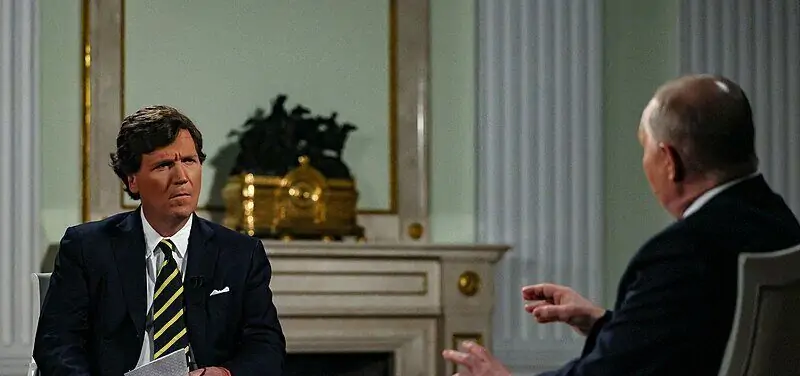
Former Fox anchor Tucker Carlson is a well-known figure representing the MAGA realm, embodying many of the successes of Trumpism and the provocative rhetorical style of the Western far right more globally. On foreign policy issues, Carlson has largely embraced the Russian narrative of the Russo-Ukrainian War, being very critical of Kyiv and sympathetic to Moscow. For that, he has been considered by the Kremlin as a tool for reaching American audiences. But Carlson’s master stroke came with his recent two-hour interview with Russian President Vladimir Putin, which was organized at the request of Carlson himself. The highly anticipated interview was an opportunity for the Russian president to speak to Western audiences—particularly those on the far right, who often see Russia as an ideological ally.
Despite wide viewership, however, the far right’s reaction to the interview was, with some exceptions, decidedly muted and in some instances even critical. Many figures on the far right either did not engage with the interview or limited their comments to mild praise for Carlson’s efforts and decided criticism of the Russian president. Overall, while there is a genuine ideological affinity between the Western far right and Russia, the interview demonstrated that their shared values are not enough to produce explicit political and policy cooperation based on well-articulated ideological arguments that might challenge liberal democracy.
The Interview Itself
The Western media reacted to the controversial interview in one of two ways. Some decided to ignore the story completely (a decision that only hurt them, given the high visibility of the event, which was a media success);[1] others deployed the usual rhetorical tools, presenting Carlson as Putin’s “useful idiot” and the Trump MAGA coalition as being on the Kremlin’s payroll. But these two stances—ignoring and denouncing—both miss the big picture: the interview was an attempt by a key figure of the MAGA culture to enter into dialogue with the leader of the Russian state, and achieved only mixed results.
Given how the interview went, it seems the questions were not pre-negotiated and the two parties had diverging expectations of how it would go. While Carlson was hoping that Putin would endorse the Trumpist vision of the world, with its grievances against liberalism, Putin was hoping to convince the broader American public that the US and Russia must somehow reconcile and resolve the war in favor of Russia’s position.
For the Kremlin, the interview was a success in the sense that it enabled Putin to appear in the Western public domain in an exceedingly popular format, even as Russian voices are largely denied access to mainstream U.S. media. The Kremlin saw an opportunity to address the American public at large and undermine the current U.S. presidential administration’s support for Ukraine. The Russian president demonstrated at length his ability to articulate his geopolitical vision of the world—whatever one thinks of that vision.
But the interview also shows the limits of the supposed partnership between U.S. conservatives and Russia. Counter to pundits’ expectations, Putin did not conduct a charm offensive toward the Republican electorate and conservative audiences more globally. He did not decry the decadent liberal West and its perverted values. When asked about God, he did not take the opportunity to comment on spirituality and traditional values—even though religion is core to American conservative discourse. Instead, he preferred to lecture his host at length on Russia’s and Ukraine’s one-thousand-year shared history—something Carlson looked clearly unprepared for. As Paul Grenier nicely framed it, Carlson “would have been happy to get an ‘elevator speech’ about Russian history that lasted the promised thirty seconds and then a list of grievances” against NATO. He got both, but not in the desired proportions.
This gives us some insights into the perception gap between U.S. conservatives, for whom “valuing historical roots” does not imply genuine knowledge of world history, and the Russian political establishment, for whom history is a driving tool for legitimizing policymaking. On several occasions, Putin displayed irritation at Carlson’s questions related to NATO expansion and the credibility of the Russian “denazification” narrative. The two interlocutors were also at odds when it came to their vision of China: the U.S. anchor repeated the usual Republican narrative of China as the new global enemy—and thus a shared foe of both the US and Russia—while Putin not only expressed a positive vision of Russia’s partnership with China, but also put China’s rise and the West’s decline in global context.
European Far-Right Reactions to the Interview
The difficulties that the Western far right and the Russian establishment faced in finding a common language were reflected in the European far right’s limited reaction to the interview. Even the German far right, which remains the most openly pro-Russian in Europe, did not devote much time to commenting on it. Some AfD (Alternative for Germany) politicians praised the video, among them Steffen Kotré, who—in the only related press release on the AfD’s Bundestag website—stressed Putin’s offer to resume supplying gas to Germany. Björn Höcke, unofficial head of the AfD’s far-right faction, also commented on the video with approbation, calling it a “journalistic tour de force.”
In the rest of Europe, discussion of the event was largely avoided, either because far-right leaders are cautious not to be seen as celebrating Russia or because they do not share a pro-Russian geopolitical orientation. Thus, while Nigel Farage, the former leader of the UK Independence Party and a figure who has forged close connections with the American far right, did comment on the interview, he largely condemned it as a “propaganda” attempt to reach American audiences. Farage added that Carlson should have been more critical and should have questioned Putin about Aleksei Navalny (still alive at the time of the interview).
In France, where the far right has historically been largely favorable to Russia, the strategy has been to tone down positive comments to avoid public criticism. Therefore, neither the official social media accounts of the National Rally’s Marine Le Pen and Jordan Bardella nor those of Reconquête’s Éric Zemmour and Marion Maréchal posted anything about the interview. A handful of less prominent individuals did comment on it, however, among them Patricia Chagnon-Clevers, an RN deputy in the European Parliament, and Nicolas Dumas, a regional representative of Reconquête.
In Spain, coverage of the interview was scarce. Several pieces identified Carlson as a “friend” of VOX leader Santiago Abascal, who interviewed him recently (and attended a right-wing rally alongside him last November), but their focus was more on Carlson than on Putin. Among the Italian far right, there was likewise little discussion of the interview—an understandable position given the pro-Atlanticist stance of Georgia Meloni.
This contrasts with the visibility, on the Russian side, of Carlson’s visit to Moscow, which was broadcast extensively on Russian state media. The far-right ideologue Alexander Dugin took the media frenzy as an opportunity to publish a post exulting the rise of “MAGA Communism:” headed by an image of Trump and Marx, the text declared that American patriots and leftists can work together to undermine U.S. global liberal hegemony.
U.S. Conservative and Far-Right Reactions to the Interview
Even in the United States, the right-wing reaction to Carlson’s interview was relatively muted. Some more mainstream conservative commentators—like Ben Shapiro, Richard Hannia, and Matt Walsh—were largely favorable about Carlson’s performance but felt that the interview was nevertheless ineffective. Hannia said that that the interview showed that Putin, due to his obsession with history, was “out of touch.” Shapiro went even further, calling Putin’s long diatribe about Russian history a poor justification for what was ultimately “a barbaric invasion of a sovereign country.”
Others appeared to accept Putin’s comments without objection. Charlie Kirk, right-wing activist and founder of Turning Point USA, reposted quotes from the interview without commentary, indicating only that Tucker’s interview was a “masterclass.” In her podcast, Candace Owens, a right-wing media personality and contributor to The Daily Wire, focused on Putin’s suggestion that the United States (including the president) was controlled by the U.S. intelligence services and praised Putin’s version of Russian history.
Radical figures on the right were markedly more receptive of the interview. Alt-right political activist Jack Posobiec commented on his show, “Human Events,” that while he disagreed with much of what Putin had said, it was noteworthy that the Russian president was willing to make peace in spite of the historical grievances. He also remarked that it was impressive of Putin to talk at length about Russian history, comparing him favorably with U.S. President Joe Biden, whom Posobiec decried as “essentially a vegetable.” Russian apologist and far-right commentator Jackson Hinkle provided a chaotic analysis of the interview in conversation with alt-right podcaster Elija Schaffer; both figures were generally supportive of Putin and mainly complained that Zelensky was treated too gently by Western journalists. The same opinion was expressed by alt-right media personality Tim Pool, who complained that the media did a worse job interviewing Zelensky.
Alt-right commentator Nick Fuentes held a watch party during the broadcast of Carlson’s interview of Putin. During the livestream, he called Putin a “real leader” and a “real boss,” repeatedly affirming his admiration of the Russian president. While he did levy some criticisms at the interview, these were limited to saying that the history lesson would not resonate with an American audience and that the interview as a whole was “not groundbreaking,” as no new information or revelations surfaced.
In general, Republican lawmakers have remained critical of Putin and have rejected Carlson’s efforts to undermine support for Ukraine. However, this stance is not entirely unanimous. Following Tucker’s announcement that he would conduct an interview with Putin, Marjorie Taylor Green (R-GA) defended the initiative. Matt Gaetz (R-FL) similarly welcomed the interview and, after the video was released, remarked on how impressive he found Putin’s ability to talk at length on history, contrasting this with Biden’s alleged memory issues. Senator J.D. Vance (R-OH) criticized Carlson’s failure to challenge Putin on the imprisonment of journalists but underlined the significance of Putin’s long diatribe on history, saying, “if you want to understand world affairs and make smart decisions, you have to understand how people see themselves.”
As divided as right-wing American audiences may have been in their interpretations of the interview, what is clear is that it was not a priority. Carlson’s interview with Putin was overshadowed by the regular U.S. news cycle which centered on the Supreme Court hearing oral arguments in the pending Trump v. Anderson case, and Biden’s surprise press conference in which he addressed the Justice Department Special Council’s report on his handling of classified documents. Speaking at roughly the same time as the Tucker Carlson interview went live, Biden maintained his mental sharpness but made the unfortunate gaffe of referring to Egyptian President Abdel Fattah el-Sisi as the president of Mexico. The irony was too perfect for the American right, which seized on the opportunity to mock Biden and call him mentally unfit for office.
Conclusion
There is a genuine ideological affinity between the Western far right and Russia: a shared conservative ontology of mankind that believes in inherited collective identities and the impossibility of individuals freeing themselves therefrom; a critique of democracy and liberalism, as well as of economic, normative, and cultural globalization; a vision of the nation-state as the supreme entity on the international scene; and some mutual admiration and ideological borrowing.
Yet that shared set of values is not enough to produce explicit political and policy cooperation. In that regard, it is telling that Putin decided to focus on national history as the core argument justifying the war—that is, to insist on what makes Russia unique and not on what Russia shares with the conservative West. Likewise telling is the fact that Carlson arrived unprepared to discuss—and seemingly unfamiliar with—the Russian vision of the war, seeking to introduce into the conversation the usual paradigms of American foreign policy culture with no awareness that these did not make sense to Russians.
While the Kremlin genuinely believes in the existence of a “good” West—a conservative one that is ready to reconcile in the name of well-understood national interests—this does not make Trump a natural and easy partner for Russia. This is not, of course, to say that Trumpism and Russia cannot cooperate to make decisions that would impact the world order, but a coordinated attack on liberal democracy based on well-articulated ideological arguments is not easily reachable.
Marlene Laruelle is a Research Professor of International Affairs and Political Science at the George Washington University.
John Chrobak is Program Coordinator of GW’s Illiberalism Studies Program.
A French version of the paper has been published here.
[1] X (formerly Twitter) claimed that the interview was its bigger event ever, with more than 200 million views. Knowing that a “view” is two seconds, one can obviously challenge that inflated number: there were 200 million views not of the video but of the post in which it was embedded. YouTube is stricter (counting only “views” that last 30 seconds or longer) and gives the number of views as 16 million—which is probably closer to the truth.