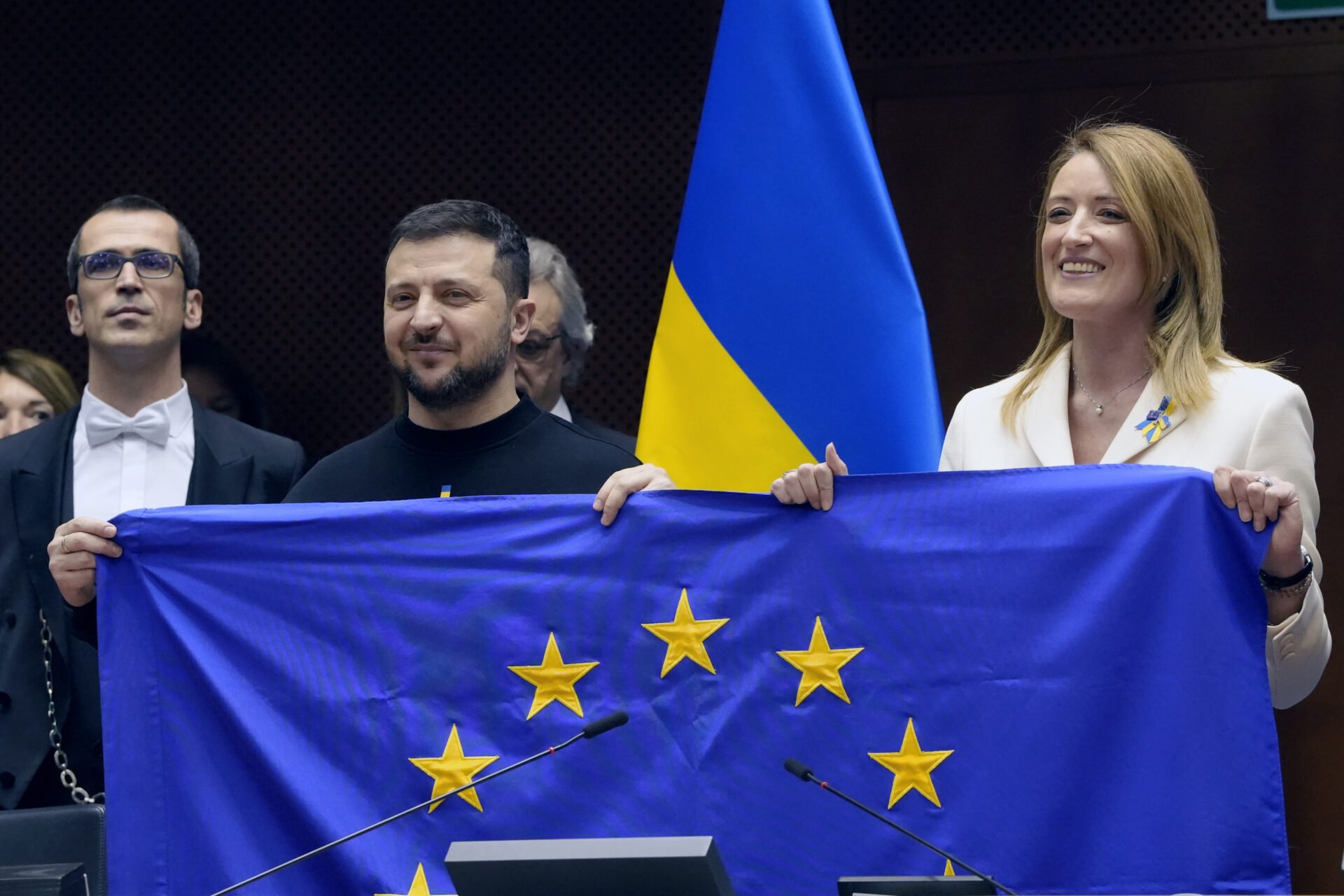
Before Russia’s full-scale invasion in February 2022, the likelihood of Ukraine joining the European Union (EU) was a distant prospect at best. Enlargement fatigue plagued many existing member states, the financial costs of membership were especially high, concerns over corruption and the quality of governance damaged Ukraine’s reputation as a reliable member, and its borders were not secure. While all these challenges persist, the debate over Ukrainian accession has changed dramatically over the past two years. European leaders have taken concrete steps to advance the accession process, suggesting that EU enlargement and the inclusion of Ukraine in the bloc is not only desirable but also feasible. European rhetoric has also been favorable, with European Commission President Ursula von der Leyen affirming in September 2023 that Ukraine’s future was “in the Union.” In Ukraine, meanwhile, optimism is stronger than ever: Prime Minister Denys Shmyhal has set a tight two-year timetable for securing EU membership, and public support for accession to the bloc remains high, at 90 percent.
Nevertheless, obstacles to Ukraine’s accession persist. Leaving aside the most important challenges related to the war in Ukraine and Ukraine’s own preparedness for membership, this memo focuses on three key EU-level reforms required to make Ukraine’s membership more realistic in the near to medium term: changing the rules of the Common Agricultural Policy, reforming how Structural and Cohesion Funds are calculated, and revisiting the need for unanimity on major EU decisions like membership. Such fundamental reform of the EU will require enormous goodwill, commitment, and vision to move ahead under the difficult current conditions.
Overcoming Institutional Challenges
Since the full-scale invasion of Ukraine in February 2022, European leaders have taken concrete steps to advance the country’s accession to the European Union. On June 23, 2022, the European Council granted Ukraine (and Moldova) candidate status with the unanimous agreement of all 27 member states. On November 8, 2023, the Commission published a 1,200-page report on the future of EU enlargement, recommending the EU move forward with formal accession negotiations for Ukraine and Moldova, while granting candidate status to Georgia. These measures were approved in December 2023, reviving a stalled EU enlargement process. Ukraine was able to make this progress despite opposition from Hungary’s Prime Minister Viktor Orbán, following a deal struck by Orbán and the European Commission for the release of budgetary funds that had been frozen due to Hungary’s democratic backsliding. In a creative move, Orbán allowed for a unanimous vote to be held, formally launching accession negotiations, by leaving the room during the vote.
These important steps have been accompanied by encouraging rhetoric in European circles. European Council President Charles Michel echoed President Ursula von der Leyen, stating, “It is our duty to make sure we protect the interest of the European Union by supporting Ukraine.” Moreover, the optimism expressed on the Ukrainian side is stronger than ever. In a video hailing the EU accession talks, Ukrainian President Zelensky claimed, “We have dispelled doubts…There will be another victorious decision—the time will come when we will be able to celebrate Ukraine’s accession to the EU.”
Despite these encouraging words and the significant change in elite and public attitudes toward the likelihood of Ukrainian membership, accession remains an enormous challenge for reasons that go beyond the most jarring fact that Ukraine is embroiled in a deadly battle for its survival as a sovereign country. Keeping always in mind this greatest challenge of all, it is also important to pay attention to the substantial obstacles to enlargement on the EU side of this equation, which are related to Europe’s financial and structural constraints.
Even in the best of all possible circumstances—that is, were there to be a timely resolution of Ukraine’s war with Russia—there are significant issues related to the EU’s enlargement process that would need to be addressed for Europe’s welcoming rhetoric to be turned into reality. This is not just for Ukraine, but for several countries that have worked toward membership since the last successful round of enlargement over a decade ago, in which Croatia became an EU member. As French President Macron stated clearly this past December, “any enlargement will require in-depth reform of our rules and that will only be possible with either a massive increase in funding or a change in the rules and mechanisms that we have today.”
Common Agricultural Policy (CAP)
A particularly large barrier to enlargement is the EU’s current Common Agricultural Policy (CAP), a program created in 1962 with the main goal of increasing agricultural production in the European Community and insulating the European market from global competition. Today, it accounts for 33.1 percent of the EU-27 budget, at EUR 55.7 billion (2021 figures). The vast majority of CAP funding (76.8 percent) goes to direct payments to farmers and agricultural market measures.
If Ukraine were to join the EU, it would become the bloc’s largest recipient of CAP funding due to its geographic size and the scale of its agricultural industry, meaning that farmers in existing member states would have to accept lower payments to accommodate Ukraine. Right now, France and Spain are the largest recipients of CAP, receiving 17 percent and 12 percent of CAP funds, respectively. They also possess the largest sections of cultivatable land in the EU. While this may look quite different at the conclusion of the war, before the fighting in 2022, Ukraine reportedly had 42.5 million hectares of functional agricultural land, which would constitute 21 percent of the EU’s total farmland. Thus, Ukraine would surpass France as the EU country with the most agricultural land by more than 14 million hectares.
Because the EU allocates funds on a per-hectare basis, the mere size of Ukraine means that French and Spanish farmers would have to receive significantly smaller payments to balance the European Agricultural Guarantee Fund (EAGF) budget. Additionally, per-hectare allocation of direct payments favors large farms, a highly criticized policy that leaves small farmers without support. Once again, this approach favors Ukrainian farmers: the country’s agricultural industry is dominated by around a dozen oligarchs who control 71 percent of the country’s agricultural output.
Even at the peak of wartime sympathy for Ukraine, European farmers expressed anger over their inability to compete with Ukrainian grain imports. In the spring of 2023, Ukraine’s free access to the EU market caused a glut of grain and other agricultural products, resulting in the collapse of grain prices and crippling Central European markets in particular. The result was an EU ban on grain exports to Poland, Hungary, and Slovakia. More recently, Polish farmers and now truckers have taken competition matters into their own hands: a blockade at the Medyka border crossing began on November 6, 2023, to stop Ukrainian truckers and farm products from entering the country.
In other words, unless Europe’s Common Agricultural Policy is reformed, Ukraine’s membership would not only trigger a massive reallocation of funds, but would also likely depress prices. Given that European farmers have experienced high and stable prices for decades, the lower prices on agricultural products that Ukraine could bring to the European market would likely require side compensation to European farmers. This would further strain the EU budget and potentially the willingness of politicians in key member states to support Ukrainian membership when the farmers ratchet up the pressure on their leaders.
Cohesion Fund
The EU’s Cohesion Fund is intended to provide money to poorer regions, with a view to boosting their economies and standards of living and promoting EU cohesion. Specifically, the Cohesion Fund provides economic support for countries whose Gross National Income (GNI) per capita is below 90 percent of the EU-27 average. Even before the devastating war, Ukraine would have been the poorest member, with all its regions falling below the threshold. As of 2022, Ukraine’s GNI per capita was $13,360, compared to the EU’s $39,676, or 33 percent of the EU average. Net recipient countries in the 2021-2027 budget—Bulgaria, the Czech Republic, Estonia, Greece, Croatia, Cyprus, Latvia, Lithuania, Hungary, Malta, Poland, Portugal, Romania, Slovakia, and Slovenia—would either receive substantially less funding or become net benefactors. This shift from recipient to benefactor status would likely spark political resistance to enlargement in some existing member states.
At present, the makeup of the EU and European Parliament reflects the dominant role of large Western European states, while many of the states currently receiving support from the EU’s Structural and Cohesion Funds are geographically located in Eastern Europe. Hence, the economic modernization of new member states has largely been funded by Western member states. According to one study, barring a change to the budgetary rules, Ukraine would become the largest beneficiary, receiving 41.7 percent of EU financial aid following enlargement.
Poland would receive the next largest percentage of aid, at 12.6 percent of these funds, instead of the 30 percent it currently enjoys. To date, Poland and other countries in Eastern Europe remain some of Ukraine’s most vocal supporters, but a new allocation would threaten this support. While Poland’s newly elected government, led by Prime Minister Donald Tusk, intends to back Ukrainian membership fully, he will have to contend with less supportive opposition parties and leaders (who are responsible for Poland’s inability to receive in full frozen EU funds), not to mention overcome grassroots popular pressure from groups hurt by a fall in EU transfers.
In sum, given that enlargement would lead to the reallocation of the EU’s Structural and Cohesion Funds and CAP funds, which together account for around 60 percent of the EU’s total budget, major budgetary reform must occur to smooth over anticipated political hurdles in recipient states. Indeed, it is unclear at present how the EU could accommodate the new costs of Ukraine’s membership in the current budget cycle (2021-2027) without a radical overhaul of these two programs.
The Unanimity Requirement for EU Enlargement
The greatest non-budgetary challenge to enlargement relates to the formal voting and ratification procedures. Past EU enlargement required unanimous support from all existing members along with national-level referenda. While national leaders have expressed strong support for Ukrainian membership, this may change if domestic political costs become too high for elected leaders to bear. According to a Flash Eurobarometer survey conducted in November 2023, 61 percent of EU citizens approve of the EU granting candidate status to Ukraine, but this support is not evenly distributed across the Union. Indeed, support for further EU enlargement in France and Germany polled at 37 percent and 38 percent, respectively.
The requirement of unanimous support from all 27 member states means that gaining approval for Ukraine’s membership will be a difficult feat. This feels especially challenging at present, considering that Prime Ministers Robert Fico of Slovakia and Orbán of Hungary have expressed clear opposition to Ukrainian accession. Indeed, since February 2022, Hungary’s government has played a divisive role. It has refused to participate in EU energy policy limiting Russian energy purchases and, in December 2023, vetoed a deal to grant Ukraine 18 billion euros ($19.4 billion) to support Kyiv’s war effort.
Under the unanimous voting structure required for important foreign policy and security decisions (including EU enlargement), any one country holds the power to block the European Union’s expansion and other important foreign policy decisions. After the accession negotiations vote from which Orbán was absent, German Chancellor Olaf Scholz stated, “Things can’t be solved every time by [him] leaving the room.” A further concern related to the unanimity requirement is that it diminishes the leverage that EU leaders have in dealing with democratic backsliding. At some point, this tradeoff may not seem worth the progress in enlargement.
In the past, the EU’s internal consolidation and cohesion have taken precedence over its foreign policy ambitions. The stalled membership applications of the states in the Western Balkans exemplify this. Minor disputes among neighbors have also played a role in blocking enlargement. In November 2020, Bulgaria blocked North Macedonia’s EU candidacy, alleging that the Macedonian language was a dialect of Bulgarian and that Macedonia was disrespecting its shared culture and historical ties to Bulgaria. Disputes like these can prevent an applicant from joining, yet the EU has no formal mechanism for resolving them.
Conclusion
While EU rhetoric and support for Ukraine present an optimistic view of Ukraine’s future in Europe, difficult reforms—to the Common Agricultural Policy, to the reallocation of money from the Structural and Cohesion Funds, and to the unanimity requirement for EU enlargement—are essential. If EU leaders want their words of optimism to ring true rather than hollow, they should commence the serious work necessary to reform these key budgetary and institutional arrangements before they derail progress toward future phases of enlargement.
Hilary Appel is the Podlich Family Professor of Government and George R. Roberts Fellow at Claremont McKenna College.
Madeline Dornfeld is a student at Claremont McKenna College.