PONARS Eurasia
  • About Us
    • Contact Us!
    • Membership
      • All Members
      • Core Members
      • Collegium Members
      • Associate Members
      • About Membership
    • Our Ukraine Experts
    • Executive Committee
  • Our Ukraine Experts
  • Policy Memos
    • List of Policy Memos
    • PONARS Eurasia’s Newest eBooks
    • Submissions
  • Online Academy
  • Events
    • Past Events
  • Recommended
  • Task Forces
    • Ukraine
      • PONARS Ukraine Task Force: Incontrovertible Truths
    • Amplifying Voices of Europe, the Caucasus, and Central Asia (AVECCA)
    • Russia in a Changing Climate
  • Podcasts
Contacts

Address
1957 E St NW,
Washington, DC 20052

[email protected]
202.994.5915

NEWSLETTER
Facebook
Twitter
YouTube
Podcast
PONARS Eurasia
PONARS Eurasia
  • About Us
    • Contact Us!
    • Membership
      • All Members
      • Core Members
      • Collegium Members
      • Associate Members
      • About Membership
    • Our Ukraine Experts
    • Executive Committee
  • Our Ukraine Experts
  • Policy Memos
    • List of Policy Memos
    • PONARS Eurasia’s Newest eBooks
    • Submissions
  • Online Academy
  • Events
    • Past Events
  • Recommended
  • Task Forces
    • Ukraine
      • PONARS Ukraine Task Force: Incontrovertible Truths
    • Amplifying Voices of Europe, the Caucasus, and Central Asia (AVECCA)
    • Russia in a Changing Climate
  • Podcasts
DIGITAL RESOURCES
digital resources

Bookstore 📚

Knowledge Hub

Course Syllabi

Point & Counterpoint

Policy Perspectives

RECOMMENDED
  • Misconceptions about Eastern Europe, the Caucasus, and Central Asia and Their Impact on Policy

    View
  • Five Years into the War, Ukraine Is Showing Grittiness, Rebounding Confidence in War Fortunes

    View
  • Russia’s Wartime Internet: A Contested Space with the Regime Still Predominant

    View
  • Why Georgians Need to Take Hungarian Lessons

    View
  • The ‘Don’t Lose Lukashenko’ Approach: Kyiv’s (Non-) Strategic Ambiguity Toward the Belarusian Opposition

    View
RSS PONARS Eurasia Podcast
  • The Putin-Xi Summit: What's New In Their Joint Communique ? February 23, 2022
    In this week’s PONARS Eurasia Podcast, Maria Lipman speaks with Russian China experts Vita Spivak and Alexander Gabuev about the February meeting between Vladimir Putin and Xi Jinping, and what it may tell us about where the Russian-Chinese relationship is headed.
  • Exploring the Russian Courts' Ruling to Liquidate the Memorial Society January 28, 2022
    In this week’s PONARS Eurasia Podcast, Maria Lipman chats with scholars Kelly Smith and Benjamin Nathans about the history, achievements, and impending shutdown of the Memorial Society, Russia's oldest and most venerable civic organization, and what its imminent liquidation portends for the Russian civil society.
  • Russia's 2021 census and the Kremlin's nationalities policy [Lipman Series 2021] December 9, 2021
    In this week’s PONARS Eurasia Podcast, Maria Lipman chats with social scientist Andrey Shcherbak about the quality of the data collected in the recent population census and the goals of Vladimir Putin's government's nationalities policy
  • Active citizens of any kind are under threat [Lipman Series 2021] November 5, 2021
    In this week’s PONARS Eurasia Podcast, Maria Lipman chats with Alexander Verkhovsky about the Kremlin's ever expanding toolkit against political and civic activists, journalists, and other dissidents.
  • Russia's Legislative Elections followup [Lipman Series 2021] October 4, 2021
    In this week’s PONARS Eurasia Podcast, Maria Lipman chats with Tanya Lokot and Nikolay Petrov about the results of Russia’s legislative elections and about what comes next.
  • Why Is the Kremlin Nervous? [Lipman Series 2021] September 14, 2021
    In this week’s PONARS Eurasia Podcast, Maria Lipman chats with Ben Noble and Nikolay Petrov about Russia’s September 17-19 legislative elections, repressive measures against electoral challengers, and whether to expect anything other than preordained results.
  • Vaccine Hesitancy in Russia, France, and the United States [Lipman Series 2021] August 31, 2021
    In this week's PONARS Eurasia Podcast episode, Maria Lipman chats with Denis Volkov, Naira Davlashyan, and Peter Slevin about why COVID-19 vaccination rates are still so low across the globe, comparing vaccine hesitant constituencies across Russia, France, and the United States.  
  • Is Russia Becoming More Soviet? [Lipman Series 2021] July 26, 2021
      In a new PONARS Eurasia Podcast episode, Maria Lipman chats with Maxim Trudolyubov about the current tightening of the Russian political sphere, asking whether or not it’s helpful to draw comparisons to the late Soviet period.
  • The Evolution of Russia's Political Regime [Lipman Series 2021] June 21, 2021
    In this week's episode of the PONARS Eurasia Podcast, Maria Lipman chats with Grigory Golosov and Henry Hale about the evolution of Russia's political regime, and what to expect in the lead-up to September's Duma elections.
  • Volodymyr Zelensky: Year Two [Lipman Series 2021] May 24, 2021
    In this week's episode of the PONARS Eurasia Podcast, Maria Lipman chats with Sergiy Kudelia and Georgiy Kasianov about Ukrainian President Zelensky's second year in office, and how he has handled the political turbulence of the past year.
  • Commentary | Комментарии

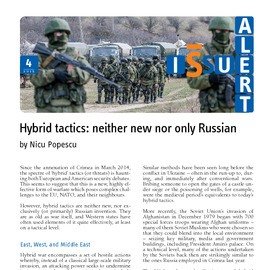
Hybrid Tactics: Neither New nor only Russian

  • February 11, 2015
  • Nicu Popescu

Since the annexation of Crimea in March 2014, the spectre of ‘hybrid’ tactics (or threats) is haunting both European and American security debates. This seems to suggest that this is a new, highly effective form of warfare which poses complex challenges to the EU, NATO, and their neighbours. However, hybrid tactics are neither new, nor exclusively (or primarily) a Russian invention. They are as old as war itself, and Western states have often used elements of it quite effectively, at least on a tactical level.

East, West, and Middle East

Hybrid war encompasses a set of hostile actions whereby, instead of a classical large-scale military invasion, an attacking power seeks to undermine its opponent through a variety of acts including subversive intelligence operations, sabotage, hacking, and the empowering of proxy insurgent groups. It may also spread disinformation (in target and third countries), exert economic pressure and threaten energy supplies. In order to be successfully executed, a degree of integration between these elements is required, as is their subordination to some sort of strategic command. It is also imperative that the aggressor be in a position to plausibly deny having supported these actions to the local and international communities.

Similar methods have been seen long before the conflict in Ukraine – often in the run-up to, during, and immediately after conventional wars. Bribing someone to open the gates of a castle under siege or the poisoning of wells, for example, were the medieval equivalents to today’s hybrid tactics. More recently, the Soviet Union’s invasion of Afghanistan in December 1979 began with 700 special forces troops wearing Afghan uniforms – many of them Soviet Muslims who were chosen so that they could blend into the local environment – seizing key military, media and government buildings, including President Amin’s palace. On a technical level, many of the actions undertaken by the Soviets back then are strikingly similar to the ones Russia employed in Crimea last year.

The US has also made effective use of hybrid tactics: notably against the Soviet Union in Afghanistan in the 1980s, and then again immediately before its attempt to dislodge the Taliban with Operation Enduring Freedom in 2001. But the US has also suffered many casualties as a result of this type of warfare – in Afghanistan itself and also in Iraq. What military experts call ‘asymmetric’ warfare could also fall into this category. In Lebanon, for example, Hizbullah went from mounting traditional guerrilla operations during the country’s civil war to making use of hybrid warfare during its conflict with the Israeli army in 2006.

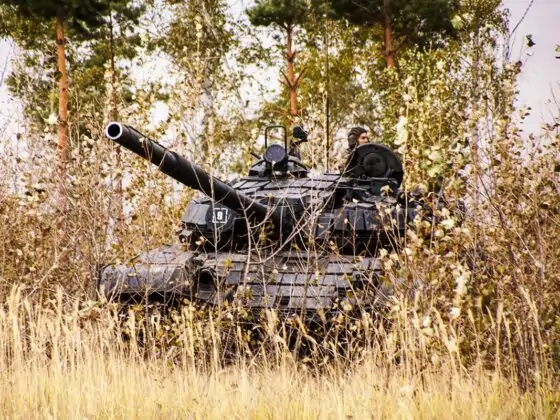
That such tactics – long part of Russia’s military doctrine and debates – were employed in Ukraine is no big surprise. What was impressive is that Russia managed to assemble and deploy the various elements in near perfect coordination. There are people in Russia, Ukraine and even the West who still think that the “little green men” who took over Crimea were locals – even months after Putin himself acknowledged that Russian troops were indeed present.

Conventional vs. hybrid

For countries like Ukraine, hybrid warfare is a tangible threat, but for most European states it poses less of a danger. Such tactics worked so well in parts of eastern Ukraine because it is hard to imagine a more favourable ground: a contested, passive or near-absent sense of Ukrainian identity, estrangement from the new authorities in Kiev, a large-scale Russian military and intelligence presence in Sevastopol, and the domination of Russia-based media outlets. Due to this climate, for it was not just easy for Russia; it was almost effortless.

Such conditions, however, are unlikely to be replicated on a comparable scale elsewhere. It should also be acknowledged that Ukraine also eventually managed to strike back. Hybrid war was possible between late February and mid-May 2014, immediately after Yanukovich fled and Ukraine lacked a functioning government which could effectively command the police, intelligence services and army. Russian volunteers and (most probably) intelligence operatives simply filled the void and in doing so were able to take over swathes of territory. For its part, Moscow amassed its armed forces along the border with Ukraine to dissuade Kiev from opting for a largescale military response.

By mid-May 2014, however, the Ukrainians were able to put up a certain level of resistance, and, after Poroshenko’s election, launched a conventional military campaign which helped them recapture almost half of the territory initially lost. Although the Ukrainian army was weak, disorganised and demotivated, and pro-Ukrainian volunteer groups under-equipped, they nevertheless managed to significantly roll back the separatists between June and August.

This forced Moscow to drop its hybrid tactics in favour of conventional methods of aggression, such as shelling Ukrainian territory and sending troops across the border under the guise of being ‘volunteers’. Ever since, the conflict has not been hybrid at all (as the current rebel offensive to take Mariupol also proves). One reason why hybrid war is so dangerous and potentially destabilising is that it is easy and cheap to launch for external aggressors, but costly in various ways for the defenders. While an attacker can try and hide behind plausible deniability, those responding are immediately placed in the spotlight. The Ukrainian army’s assault using heavy weaponry – rather than surgical urban warfare – on rebel areas caused a large number of civilian casualties. This had the effect of both alienating the central government from people in the east of the country and damaging its reputation abroad. Were it not for the tragedy of the MH-17 flight, allegedly shot down by the Donbas separatists, the international community would have probably been much more focused on the conduct of the war by Kiev.

Between the Alliance and the Union

It still appears highly unlikely that Russia will attempt to start seizing chunks of NATO members’ territory with “little green men”. But attempts to destabilise governments and embarrass both the EU and NATO through low-scale operations – what some call ‘poking and probing’ – are not inconceivable. Responding effectively to hybrid tactics in Europe would require a coordinated approach from both organisations. The Alliance can take action, primarily, in the military and intelligence fields – through deterrence and, if necessary, direct intervention. But the very nature of the threat requires a wider array of tools: well-trained police forces, functioning border management systems, and effective anti-corruption agencies, as well as transparency in the energy sector and in party political funding. It is here that the Union can make a real difference in contributing to a combined and integrated response.

Neither the Alliance nor the Union can guarantee the absolute security of their partners in the face of future threats, but they can, however, help them build resilience to hybrid tactics.

– – – – – 

View this article at EUISS here and ISN here | PDF

© EUISS [Alert No. 4, 1/30/15]

Related Topics
  • Popescu
  • Russia
  • Ukraine
Previous Article
  • In the News | Hовости

Последний шанс остановить войну

  • February 10, 2015
  • Olexiy Haran
View
Next Article
  • Policy Memos | Аналитика

Could Russia Become a Serious Spoiler in the Middle East?

  • February 11, 2015
  • Pavel Baev
View
You May Also Like
View
  • Commentary | Комментарии
  • Recommended | Рекомендуем

Clearing the Air: Secretary Blinken Visits Ukraine

  • Volodymyr Dubovyk
  • September 19, 2023
View
  • Commentary | Комментарии
  • Recommended | Рекомендуем

Ensuring Genuine Results? A New Electoral Design in Uzbekistan

  • Akrom Avezov
  • May 19, 2023
View
  • Commentary | Комментарии
  • Recommended | Рекомендуем

Ukraine, Taiwan, and Macron’s “Strategic Autonomy”

  • Maurizio Delli Santi
  • April 30, 2023
View
  • Commentary | Комментарии
  • Recommended | Рекомендуем

Russia’s Regional Governors: Backing the War, Upholding the Status Quo

  • Irina Busygina and Mikhail Filippov
  • April 7, 2023
View
  • Commentary | Комментарии
  • Recommended | Рекомендуем

The Desire to Possess: Russia’s War for Territory

  • Irina Busygina
  • February 8, 2023
View
  • Commentary | Комментарии
  • Recommended | Рекомендуем

Kyiv-Washington Relations in Times of Colossal War: The Ultimate Test of a Strategic Partnership

  • Volodymyr Dubovyk
  • January 11, 2023
View
  • Commentary | Комментарии
  • Recommended | Рекомендуем

Prevailing Soviet Legacies

  • Irina Busygina and Mikhail Filippov
  • December 27, 2022
View
  • Commentary | Комментарии
  • Recommended | Рекомендуем

In Russia’s Nuclear Messaging to West and Ukraine, Putin Plays Both Bad and Good Cop

  • Simon Saradzhyan
  • December 23, 2022

Leave a Reply Cancel reply

Your email address will not be published. Required fields are marked *

PONARS Eurasia
  • About Us
  • Membership
  • Policy Memos
  • Recommended
  • Events
Powered by narva.io

Permissions & Citation Guidelines

Input your search keywords and press Enter.