PONARS Eurasia
  • About Us
    • Contact Us!
    • Membership
      • All Members
      • Core Members
      • Collegium Members
      • Associate Members
      • About Membership
    • Our Ukraine Experts
    • Executive Committee
  • Our Ukraine Experts
  • Policy Memos
    • List of Policy Memos
    • PONARS Eurasia’s Newest eBooks
    • Submissions
  • Online Academy
  • Events
    • Past Events
  • Recommended
  • Task Forces
    • Ukraine
      • PONARS Ukraine Task Force: Incontrovertible Truths
    • Amplifying Voices of Europe, the Caucasus, and Central Asia (AVECCA)
    • Russia in a Changing Climate
  • Podcasts
Contacts

Address
1957 E St NW,
Washington, DC 20052

[email protected]
202.994.5915

NEWSLETTER
Facebook
Twitter
YouTube
Podcast
PONARS Eurasia
PONARS Eurasia
  • About Us
    • Contact Us!
    • Membership
      • All Members
      • Core Members
      • Collegium Members
      • Associate Members
      • About Membership
    • Our Ukraine Experts
    • Executive Committee
  • Our Ukraine Experts
  • Policy Memos
    • List of Policy Memos
    • PONARS Eurasia’s Newest eBooks
    • Submissions
  • Online Academy
  • Events
    • Past Events
  • Recommended
  • Task Forces
    • Ukraine
      • PONARS Ukraine Task Force: Incontrovertible Truths
    • Amplifying Voices of Europe, the Caucasus, and Central Asia (AVECCA)
    • Russia in a Changing Climate
  • Podcasts
DIGITAL RESOURCES
digital resources

Bookstore 📚

Knowledge Hub

Course Syllabi

Point & Counterpoint

Policy Perspectives

RECOMMENDED
  • Misconceptions about Eastern Europe, the Caucasus, and Central Asia and Their Impact on Policy

    View
  • Five Years into the War, Ukraine Is Showing Grittiness, Rebounding Confidence in War Fortunes

    View
  • Russia’s Wartime Internet: A Contested Space with the Regime Still Predominant

    View
  • Why Georgians Need to Take Hungarian Lessons

    View
  • The ‘Don’t Lose Lukashenko’ Approach: Kyiv’s (Non-) Strategic Ambiguity Toward the Belarusian Opposition

    View
RSS PONARS Eurasia Podcast
  • The Putin-Xi Summit: What's New In Their Joint Communique ? February 23, 2022
    In this week’s PONARS Eurasia Podcast, Maria Lipman speaks with Russian China experts Vita Spivak and Alexander Gabuev about the February meeting between Vladimir Putin and Xi Jinping, and what it may tell us about where the Russian-Chinese relationship is headed.
  • Exploring the Russian Courts' Ruling to Liquidate the Memorial Society January 28, 2022
    In this week’s PONARS Eurasia Podcast, Maria Lipman chats with scholars Kelly Smith and Benjamin Nathans about the history, achievements, and impending shutdown of the Memorial Society, Russia's oldest and most venerable civic organization, and what its imminent liquidation portends for the Russian civil society.
  • Russia's 2021 census and the Kremlin's nationalities policy [Lipman Series 2021] December 9, 2021
    In this week’s PONARS Eurasia Podcast, Maria Lipman chats with social scientist Andrey Shcherbak about the quality of the data collected in the recent population census and the goals of Vladimir Putin's government's nationalities policy
  • Active citizens of any kind are under threat [Lipman Series 2021] November 5, 2021
    In this week’s PONARS Eurasia Podcast, Maria Lipman chats with Alexander Verkhovsky about the Kremlin's ever expanding toolkit against political and civic activists, journalists, and other dissidents.
  • Russia's Legislative Elections followup [Lipman Series 2021] October 4, 2021
    In this week’s PONARS Eurasia Podcast, Maria Lipman chats with Tanya Lokot and Nikolay Petrov about the results of Russia’s legislative elections and about what comes next.
  • Why Is the Kremlin Nervous? [Lipman Series 2021] September 14, 2021
    In this week’s PONARS Eurasia Podcast, Maria Lipman chats with Ben Noble and Nikolay Petrov about Russia’s September 17-19 legislative elections, repressive measures against electoral challengers, and whether to expect anything other than preordained results.
  • Vaccine Hesitancy in Russia, France, and the United States [Lipman Series 2021] August 31, 2021
    In this week's PONARS Eurasia Podcast episode, Maria Lipman chats with Denis Volkov, Naira Davlashyan, and Peter Slevin about why COVID-19 vaccination rates are still so low across the globe, comparing vaccine hesitant constituencies across Russia, France, and the United States.  
  • Is Russia Becoming More Soviet? [Lipman Series 2021] July 26, 2021
      In a new PONARS Eurasia Podcast episode, Maria Lipman chats with Maxim Trudolyubov about the current tightening of the Russian political sphere, asking whether or not it’s helpful to draw comparisons to the late Soviet period.
  • The Evolution of Russia's Political Regime [Lipman Series 2021] June 21, 2021
    In this week's episode of the PONARS Eurasia Podcast, Maria Lipman chats with Grigory Golosov and Henry Hale about the evolution of Russia's political regime, and what to expect in the lead-up to September's Duma elections.
  • Volodymyr Zelensky: Year Two [Lipman Series 2021] May 24, 2021
    In this week's episode of the PONARS Eurasia Podcast, Maria Lipman chats with Sergiy Kudelia and Georgiy Kasianov about Ukrainian President Zelensky's second year in office, and how he has handled the political turbulence of the past year.
  • Commentary | Комментарии

Is Anyone in Charge of the Russian Nationalists Fighting in Ukraine?

  • June 27, 2014
  • Marlene Laruelle

As discussions swirl about the effectiveness of the current cease fire in Ukraine, it is becoming increasingly clear that the separatists fighting there have become important actors in their own right, much as Kimberly Marten predicted in the Monkey Cage blog. Moreover, in addition to homegrown Ukrainian separatists, we also now have to consider the motivation and capabilities of Russian nationalists who have come to Ukraine ostensibly to aid the separatists in their fight.                                                                                      [See this post on the Monkey Cage blog]

In interviews conducted last week in Moscow with several major figures from Russian nationalist movements and Russian experts studying them (no names will be given in order to preserve their anonymity and security), the picture that emerges above all is one of anarchy. Obviously these narratives must be taken with caution, and reflect only the partial reality of some actors, but it struck me how they themselves are surprised by the overall opaqueness in which they are operating.

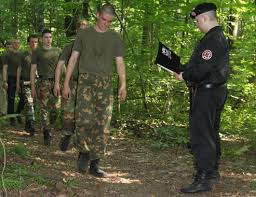
According to estimates from those I interviewed, between 100 and 200 Russian volunteers have left for Donbass. It is important to distinguish volunteers from mercenaries. Volunteers are usually young men, without families, with limited or no military training, hoping for a romantic ‘rite of passage’ on a battlefield, a la Byron. Mercenaries, on the other hand, are often former security services officers or army contractors who fought in Afghanistan, Chechnya, or Yugoslavia, who are well trained, unable to return to civil life, and follow a field commander in whom they believe. Many mercenaries are related, directly or indirectly, to the Russian National Unity (RNU) movement of Alexander Barkashov, traditionally very active in the regions close to the borders of Ukraine and North Caucasus, and which offers serious paramilitary training (see one of their propaganda videoclips). The RNU is supposedly closely associated to members of the self-proclaimed government of Donetsk and in particular of Dmitri Boitsov, leader of the Orthodox Donbass organization, who is said to have been taken orders directly from Barkashov.

The volunteers come from several other Russian nationalist groups: the Eurasianist Youth inspired by the Fascist and neo-Eurasianist geopolitician Alexander Dugin; the now-banned Movement Against Illegal Immigration led by Alexander Belov; the group ‘Sputnik and Pogrom’; the national-socialist Slavic Union of Dmitri Demushkin; several small groups inspired by monarchism such as the Russian Imperial Movement; and some from the more Western-oriented groups such as the Russian Social Movement of Konstantin Krylov, often defined as a ‘national-democrat’. However, with the exception of the RNU, heavily involved in Donetsk, these groups do necessarily cover all volunteers, as the majority of them left of their own initiative and using their own funds. Some groups such as the Russian Social Movement do not organize the departure of their young volunteers, others like the Eurasianists seem more disposed to build networks that facilitate these trips.

Nonetheless, several of the groups do provide humanitarian aid (mostly medicine) and send light weapons and ammunition (although it should be noted that this is done individually by the different groups and not in a coordinated manner). Their ability to deliver weapons and ammunition remains modest and should not be exaggerated. That they can do this at all is thanks to their links to some paramilitary groups and to officers retired from active service who know how to obtain decommissioned Soviet-era weapons stockpiles. According to my interviews, Russian border guards and Cossack troops that patrol the Russian side do not welcome these volunteers, who either pass through outside check points or bribe border guards. Once in the Lugansk and Donetsk regions, utter anarchy reigns; each group exacts significant bribes, even from those who come to help them.  Those caught at the border by Russian border guards are repatriated back to Moscow or St Petersburg, and some seem to have been jailed.

What conclusions can be drawn from these narratives? First of all these few volunteers, both in their unpreparedness and their lack of integration into a chain of command, put in peril not only their own lives, but those of civilians in Donetsk and Lugansk. In addition, these missions may be of concern to the Kremlin as well, which sees them as rogue elements who are likely to one day return to Russia and will bring back with them their experiences of urban warfare.

More fundamentally, these narratives shed light on the operation of the Russian state. When Vladimir Putin personally makes a decision, as was the case for the annexation of Crimea, the Russian state is highly functional: the chain of command is fully, flawlessly operational, and both the administrative and public affairs apparatuses operate in a clearly defined and controlled manner. When the Kremlin decided to exit the situation in order to create a lawless zone in which it is impossible to determine responsibilities, the Russian state became highly chaotic. Russian nationalist movements are a part of this anarchy, alongside experimental field commanders like Igor Strelkov, militia mercenaries, and corrupt former officers who participate in it for both ideological and financial reasons.

Of course this ‘laissez-faire’ attitude is in the Kremlin’s interests. It allows for the futures of Ukraine and the Kyiv government to be permanently weakened, and avoids the necessity of assuming international responsibilities. Some figures close to the Russian authorities add to the complexity of the pictures, such as Orthodox oligarch Konstantin Malofeev, who many suspect of funding the self-proclaimed government of Donetsk. However, it seems also accurate to see the situation as a Pandora’s box that the Kremlin is now struggling to close, seriously concerned about the long term impact of this Russian nationalist junta that could potentially turn against Moscow. Donbass is a mess not only for Kyiv, which is unable to manage a flawless military operation, but also for Moscow. It remains to be seen whether order can be restored on the Russian insurgent side in coming weeks. In any case the irony of the history is that a man so risk averse and wedded to the status quo as Vladimir Putin, whether consciously or not, himself may have initiated dynamics that are no longer under his control.

See this post on the Monkey Cage blog | Marlene Laruelle

Related Topics
  • Russia
  • Ukraine
Previous Article
  • In the News | Hовости

Gorenburg: The Russian government is not taking a lead role in Ukraine’s east as it did in Crimea

  • June 27, 2014
  • Dmitry Gorenburg
View
Next Article
  • In the News | Hовости

Барака Обаму вызывают в суд

  • June 27, 2014
  • Mikhail Troitskiy
View
You May Also Like
View
  • Commentary | Комментарии
  • Recommended | Рекомендуем

Clearing the Air: Secretary Blinken Visits Ukraine

  • Volodymyr Dubovyk
  • September 19, 2023
View
  • Commentary | Комментарии
  • Recommended | Рекомендуем

Ensuring Genuine Results? A New Electoral Design in Uzbekistan

  • Akrom Avezov
  • May 19, 2023
View
  • Commentary | Комментарии
  • Recommended | Рекомендуем

Ukraine, Taiwan, and Macron’s “Strategic Autonomy”

  • Maurizio Delli Santi
  • April 30, 2023
View
  • Commentary | Комментарии
  • Recommended | Рекомендуем

Russia’s Regional Governors: Backing the War, Upholding the Status Quo

  • Irina Busygina and Mikhail Filippov
  • April 7, 2023
View
  • Commentary | Комментарии
  • Recommended | Рекомендуем

The Desire to Possess: Russia’s War for Territory

  • Irina Busygina
  • February 8, 2023
View
  • Commentary | Комментарии
  • Recommended | Рекомендуем

Kyiv-Washington Relations in Times of Colossal War: The Ultimate Test of a Strategic Partnership

  • Volodymyr Dubovyk
  • January 11, 2023
View
  • Commentary | Комментарии
  • Recommended | Рекомендуем

Prevailing Soviet Legacies

  • Irina Busygina and Mikhail Filippov
  • December 27, 2022
View
  • Commentary | Комментарии
  • Recommended | Рекомендуем

In Russia’s Nuclear Messaging to West and Ukraine, Putin Plays Both Bad and Good Cop

  • Simon Saradzhyan
  • December 23, 2022

Leave a Reply Cancel reply

Your email address will not be published. Required fields are marked *

PONARS Eurasia
  • About Us
  • Membership
  • Policy Memos
  • Recommended
  • Events
Powered by narva.io

Permissions & Citation Guidelines

Input your search keywords and press Enter.