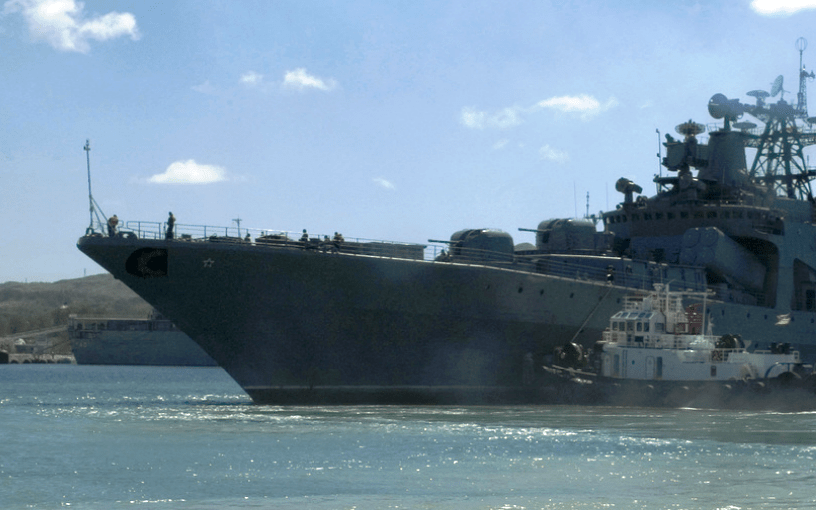
(PONARS Eurasia Policy Memo) Since its annexation of Crimea, Russia has not deviated from its coercive military behavior, displaying its military might again and again. The substance of its military exercises, however, appears to have evolved. Last October, the Grom-2019 military training simulated Russian involvement in a global nuclear war and resurrected the “nuclear card” in Russian military rhetoric. This year’s January Black Sea exercises support the argument; recall the press release from the Kremlin at the time: “Supreme Commander in Chief of the Russian Armed Forces Vladimir Putin observed… in the Black Sea… various missiles were fired… including Kalibr cruise missiles and the Kinzhal (Dagger) hypersonic air-launched ballistic missile.” These types of weapons are dual-capable (conventional and nuclear).
Considering Russia’s breadth of regular military training, what is the nuclear component in its Black Sea regional strategy? As the largest nuclear power, Russia holds routine drills. However, the quandary is that it brings back the “escalation for de-escalation” principle (usually disavowed by Moscow) and partially erases the substantial accent that Russia has been placing on its conventional deterrence. Of primary concern are the recent—since 2015—references to possible nuclear weapon deployment in the Black Sea region, which surrounds Crimea near the heart of Europe. Most of the weapons deployed in Crimea are dual-use, which, considering the normative de-escalatory mission of tactical nuclear weapons, may turn the Black Sea into one of the key points in a potential conflict. It is well known that after taking Crimea from Ukraine, Russia turned the peninsula into a “bastion of Russian glory,” a hub for power projection as one of the most militarized areas in the wider region.
Real Escalations?
According to the U.S. Nuclear Posture Review, Russian nuclear strategy calls for the early use of nuclear weapons in the event of a conflict, with the aim being to coerce a major adversary to step back from interfering in a regional conflict involving Russia and its neighbors. Policymakers in the West see this as an escalation-for-de-escalation strategy.
The idea was formulated at the beginning of the last decade when Russia was substantially inferior to the West in terms of conventional weapons and became concerned about a repetition of the Serbia scenario of 1999. In the 2000 Russian Military Doctrine, Moscow stated the possibility of using nuclear weapons in a regional war “under critical circumstances when conventional means proved their inefficiency.” Deterring conventional conflicts (especially regional wars) with nuclear weapons means that nuclear weapons are regarded as a reactive measure, serving as the main insurance that Russia will neither be defeated in nor even engaged with regional war.
In 2014, Russia’s Military Doctrine introduced the notion of conventional deterrence, which has, at a minimum, heightened the nuclear threshold and introduced the possibility that the same category of conflicts could be waged and terminated without resort to nuclear weapons. In this document, the clause of nuclear weapons use was abbreviated to: “when the existence of the state is in jeopardy,” but still, the nature of the threat was not clarified. It presented potential opponents with a wider interpretation of the term “existence,” now ranging from political regime survival to territorial integrity and cases when conventional deterrence would fail.
The last document in this area, the “Basic Principles of State Policy of the Russian Federation on Nuclear Deterrence,” published in June 2020, seems to confirm the vagueness of Russian deterrence. It essentially says the following to the West:
- Russia will use nuclear weapons in “extreme” circumstances, defining “extreme” as threatening the existence of the state or its territorial integrity—including, obviously, Crimea.
- Escalation for de-escalation is still possible, but only if Russia cannot manage with conventional weapons.
- Moscow retains vagueness in declaring the scale, time, and place of the possible use of its nuclear weapons (which also hints at engaging in de-escalation scenarios).
From multiple angles, it seems unlikely that the introduction of nuclear deterrence has removed the limited use of nuclear weapons in a regional conflict from the range of contingencies. If faced with a major defeat in a conventional conflict, Russia is nonetheless likely to cross the threshold.
From Fleet Development to New “March 1st” Weapons
Traditionally, Russia’s Navy has always been inferior to its land forces, which could be explained by Russia’s massive territory. However, the last decade saw the slow rise of the Russian fleet and the growth of its military and naval capabilities in the Black Sea, particularly during the Crimea-grabbing era. The starting point was the 2015 Russian Maritime Doctrine that noted the development of the Black Sea and Azov fleets and pointed out “the accelerated modernization and comprehensive reinforcement of the strategic position of the Russian Federation while maintaining peace and stability in the region.”
In 2017, the “The Fundamentals of the State Policy of the Russian Federation in the Field of Naval Operations for the Period Until 2030” looked much more ambitious. Words such as “nuclear and non-nuclear deterrence,” “strategic stability,” and “unacceptable damage” were widely used (compared to the 2014 Military Doctrine). Meanwhile, the most interesting part of this document is its declared readiness to use non-strategic nuclear weapons for de-escalation purposes. It states, “During the escalation of military conflict, the demonstration of readiness and determination to employ non-strategic nuclear weapons capabilities is an effective deterrent.” This document forced even some prominent Russian experts to admit the officially codified notions of escalation for de-escalation or preemptive nuclear strike.
A noteworthy passage can also be found in the Russian Deterrence Fundamentals (2020) regarding the Black Sea region. Among the “red lines” for nuclear weapons use, Article 19C notes an “attack by an adversary against critical governmental or military sites of the Russian Federation, disruption of which would undermine nuclear forces response actions.” As far as the Black Sea Fleet can be involved in escalation for de-escalation tasks, I believe that it raises the chances of Russian nuclear involvement in the region, especially if used when state territorial integrity (or Crimea’s status) is endangered.
In the end, though, it seems that an unambiguous formulation of the escalation-for-de-escalation principle can only be found in the doctrine of the slowest developing leg of the Russian strategic triad. However, this declaration has credibility. First and foremost, this is because of the rapid modernization of the Russian fleet and the introduction of the newest types of weapons along with the so-called “March 1st weapons,” a term which pertains to four types of new strategic nuclear weapons introduced by President Vladimir Putin during his Federal Assembly speech on March 1, 2018. From the four new types of new weapons, two were presented (and tested) for the Russian Navy.
The first new weapon is the Poseidon, a strategic, nuclear-powered, nuclear-armed, drone submarine, which former Pentagon official Marc Schneider called “the most irresponsible nuclear program that Putin’s Russia has ever come up with.” Meanwhile, the mission of Poseidon, apart from causing tsunamis on the U.S. coastline, is hardly incorporated into the fleet’s strategic missions. It is reminiscent of Doomsday machines and not relevant outside of an apocalyptic, nuclear-war scenario.
The second weapon is the Kinzhal hypersonic, air-launched, ballistic missile usually carried and launched by MiG-31K fighter planes. It presents a more relevant threat in the framework of the goals announced by the Navy Fundamentals. In particular, it is supposed to be produced in two versions, conventional and nuclear. According to Russian missile expert Dmitry Stefanovich, the Russian perception and missions for hypersonic weapons are quite different from that of the United States. While Americans orient toward highly precise, conventional strikes with hypersonic weapons, “for Russia, it’s the meaning of guaranteed delivery of nuclear weapons at the necessary distance.” The reason is Russia’s eternal fear that the U.S. missile defense system—in this case, in Europe—will somehow undermine their strategic deterrence capabilities. Therefore, the primary mission of Kinzhal is probably nuclear.
Another future “March 1” weapon assigned to the Russian Navy will be the hypersonic, sea-based, Tsirkon missile, which is planned to be introduced in 2022 with a range of 500-1,000 km. The Tsirkon is supposed to be an anti-ship weapon deployed by warships and submarines and launchable from those equipped with Kalibrs. The Kalibr is a sea-launched cruise missile that was successfully tested by Moscow in its military operations in Syria. It is not described as a new superweapon; however, it is considered to be one of the most effective medium-range cruise missiles available and has a range of up to 2,500 km. According to Russian experts, the main trend of the Russian Navy is to equip most submarines (28 atomic and 23 diesel) with Kalibrs, which should significantly increase the potential role of the Navy to inflict damage on an enemy.
The Role of the Russian Black Sea Fleet in Moscow’s Strategic planning
Since 2015, the armed potential of the Russian Black Sea Fleet has been growing, including Admiral Grigorovich guided-missile class frigates and Varshavyanka-class submarines, both equipped with torpedoes, cruise, and anti-ship missiles. However, there are no doubts that both frigates of this class, as well as the submarines, are also equipped with Kalibr missiles with land-attack, anti-ship, and antisubmarine warfare versions. Kalibr exists in both nuclear and in conventional versions, and when it is deployed in the Black Sea, it is capable of reaching most European NATO states. Enhanced with powerful air defense systems such as the S-400 and Bastion, Russia is working hard to fortify itself in the northern part of the Black Sea.
The Russian Black Sea Fleet may not have many warships, but the appropriate combination of offensive and defensive weapons provides it with the capability of performing tactical operations in the spirit described in the Navy Fundamentals de-escalatory actions. Its fleet’s main mission can be seen in two interconnected domains: power projection/coercion and NATO deterrence.
First, Russia will keep using the Black Sea as a platform for expanding its influence in neighboring regions, including the Balkans, the Middle East, and the Mediterranean. The main task of the Russian fleet is thus successful anti-access/area-denial (A2/AD), based on mostly conventional deterrence but still admitting a low-level nuclear operation, which is aimed at strengthening the stability of deterrence. The creation of the A2/AD area in the Black Sea also creates a strong platform for Russia’s coercive behavior, manipulating the threat to deny (or limit substantially) NATO’s military exercises in the region, for example.
Second, the Black Sea Fleet’s rise is a means of frustrating NATO. Russia seeks to deter NATO from military expansion to the southeast while neutralizing any of its new military infrastructure—particularly that which might threaten Russia’s deterrent capabilities on its southern flank. We know that the enlargement of NATO to the east as well as its European Missile Defense buildup are seen as threats by the Russian 2014 Military Doctrine.
The deployment of the Aegis Ashore site in Romania by the United States and NATO in 2016 was severely criticized by Russian officials. This situation makes the Ashore site a point of future concern for Russia, which regards it as a potential offensive military infrastructure of the Alliance. Meanwhile the recent decision by Washington to produce intermediate-range missiles that would be deployed in Europe adds fuel to the fire. Before the Crimea annexation, Russia could only target Aegis Ashore using Kalibrs (sea-launched); however, the taking over of the Ukrainian territory made reaching this goal far easier and with a wider range of ammunition.
Conclusion
Russia’s annexation of Crimea increased the Black Sea Fleet’s strategic role in many ways. In the 2020 “Basic Principles on Nuclear Deterrence,” Russia declared that its territorial integrity is essentially the main object of protection for its nuclear deterrence. This immediately raises the Crimean issue, which could be a reason for the de-escalatory use of nuclear weapons in cases where Russian conventional deterrence cannot withstand a direct military (Western) intervention. The second mission of the Black Sea Fleet is connected with the Crimea annexation and is about countering NATO Aegis Ashore missile defense sites in Europe (in Romania and soon in Poland). These developments have always been severely criticized by Moscow as being potentially not only defensive infrastructure but also offensive. By taking Crimea, Russia enhanced its strategic position in the Black Sea, denying NATO superiority at its southeastern Flank.
Polina Sinovets is Associate Professor in the Faculty of International Relations, and head of the Odessa Center for Nonproliferation, at Odessa I. I. Mechnikov National University, Ukraine.
[PDF]Homepage image credit.