PONARS Eurasia
  • About Us
    • Contact Us!
    • Membership
      • All Members
      • Core Members
      • Collegium Members
      • Associate Members
      • About Membership
    • Our Ukraine Experts
    • Executive Committee
  • Our Ukraine Experts
  • Policy Memos
    • List of Policy Memos
    • PONARS Eurasia’s Newest eBooks
    • Submissions
  • Online Academy
  • Events
    • Past Events
  • Recommended
  • Task Forces
    • Ukraine
      • PONARS Ukraine Task Force: Incontrovertible Truths
    • Amplifying Voices of Europe, the Caucasus, and Central Asia (AVECCA)
    • Russia in a Changing Climate
  • Podcasts
Contacts

Address
1957 E St NW,
Washington, DC 20052

[email protected]
202.994.5915

NEWSLETTER
Facebook
Twitter
YouTube
Podcast
PONARS Eurasia
PONARS Eurasia
  • About Us
    • Contact Us!
    • Membership
      • All Members
      • Core Members
      • Collegium Members
      • Associate Members
      • About Membership
    • Our Ukraine Experts
    • Executive Committee
  • Our Ukraine Experts
  • Policy Memos
    • List of Policy Memos
    • PONARS Eurasia’s Newest eBooks
    • Submissions
  • Online Academy
  • Events
    • Past Events
  • Recommended
  • Task Forces
    • Ukraine
      • PONARS Ukraine Task Force: Incontrovertible Truths
    • Amplifying Voices of Europe, the Caucasus, and Central Asia (AVECCA)
    • Russia in a Changing Climate
  • Podcasts
DIGITAL RESOURCES
digital resources

Bookstore 📚

Knowledge Hub

Course Syllabi

Point & Counterpoint

Policy Perspectives

RECOMMENDED
  • Why Georgians Need to Take Hungarian Lessons

    View
  • The ‘Don’t Lose Lukashenko’ Approach: Kyiv’s (Non-) Strategic Ambiguity Toward the Belarusian Opposition

    View
  • Too Much, Too Late? The Impact of Secrecy on Efforts to Mediate an End to the Russia-Ukraine War

    View
  • A Deal with the Devil: Lukashenko Navigates Domestic and External Vulnerabilities in Managing Relations with Russia

    View
  • Peacemaking Russian Style: Negotiations as the Continuation of War by Other Means

    View
RSS PONARS Eurasia Podcast
  • The Putin-Xi Summit: What's New In Their Joint Communique ? February 23, 2022
    In this week’s PONARS Eurasia Podcast, Maria Lipman speaks with Russian China experts Vita Spivak and Alexander Gabuev about the February meeting between Vladimir Putin and Xi Jinping, and what it may tell us about where the Russian-Chinese relationship is headed.
  • Exploring the Russian Courts' Ruling to Liquidate the Memorial Society January 28, 2022
    In this week’s PONARS Eurasia Podcast, Maria Lipman chats with scholars Kelly Smith and Benjamin Nathans about the history, achievements, and impending shutdown of the Memorial Society, Russia's oldest and most venerable civic organization, and what its imminent liquidation portends for the Russian civil society.
  • Russia's 2021 census and the Kremlin's nationalities policy [Lipman Series 2021] December 9, 2021
    In this week’s PONARS Eurasia Podcast, Maria Lipman chats with social scientist Andrey Shcherbak about the quality of the data collected in the recent population census and the goals of Vladimir Putin's government's nationalities policy
  • Active citizens of any kind are under threat [Lipman Series 2021] November 5, 2021
    In this week’s PONARS Eurasia Podcast, Maria Lipman chats with Alexander Verkhovsky about the Kremlin's ever expanding toolkit against political and civic activists, journalists, and other dissidents.
  • Russia's Legislative Elections followup [Lipman Series 2021] October 4, 2021
    In this week’s PONARS Eurasia Podcast, Maria Lipman chats with Tanya Lokot and Nikolay Petrov about the results of Russia’s legislative elections and about what comes next.
  • Why Is the Kremlin Nervous? [Lipman Series 2021] September 14, 2021
    In this week’s PONARS Eurasia Podcast, Maria Lipman chats with Ben Noble and Nikolay Petrov about Russia’s September 17-19 legislative elections, repressive measures against electoral challengers, and whether to expect anything other than preordained results.
  • Vaccine Hesitancy in Russia, France, and the United States [Lipman Series 2021] August 31, 2021
    In this week's PONARS Eurasia Podcast episode, Maria Lipman chats with Denis Volkov, Naira Davlashyan, and Peter Slevin about why COVID-19 vaccination rates are still so low across the globe, comparing vaccine hesitant constituencies across Russia, France, and the United States.  
  • Is Russia Becoming More Soviet? [Lipman Series 2021] July 26, 2021
      In a new PONARS Eurasia Podcast episode, Maria Lipman chats with Maxim Trudolyubov about the current tightening of the Russian political sphere, asking whether or not it’s helpful to draw comparisons to the late Soviet period.
  • The Evolution of Russia's Political Regime [Lipman Series 2021] June 21, 2021
    In this week's episode of the PONARS Eurasia Podcast, Maria Lipman chats with Grigory Golosov and Henry Hale about the evolution of Russia's political regime, and what to expect in the lead-up to September's Duma elections.
  • Volodymyr Zelensky: Year Two [Lipman Series 2021] May 24, 2021
    In this week's episode of the PONARS Eurasia Podcast, Maria Lipman chats with Sergiy Kudelia and Georgiy Kasianov about Ukrainian President Zelensky's second year in office, and how he has handled the political turbulence of the past year.
  • Commentary | Комментарии

The Role of the Black Sea Fleet in Russian Naval Strategy

  • March 6, 2014
  • Dmitry Gorenburg

The Russian military analyst Prokhor Tebin has put together a very useful article explaining Crimea’s military significance for Russia. He highlights the Black Sea’s economic significance for Russia: Russia’s Black Sea commercial ports carry 30 percent of its total maritime exports. The Black Sea also provides the closest access for Russia to the Mediterranean Sea and Indian Ocean, which is important for both economic and geopolitical reasons. Tebin points out that the Black Sea Fleet is needed to ensure that access, as well as to deal with potential  instability in the Caucasus.  It will also serve as a logistics hub for the Mediterranean task force that the Russian navy has decided to form, though ships for the task force will come from other fleets as well. He ranks the fleet third in importance for the Russian Navy, behind the Northern and Pacific Fleets, but ahead of the Baltic Fleet and the Caspian Flotilla.

The composition of the fleet is currently inadequate for its missions. It has only a few old Soviet-era ships: one missile cruiser, three frigates, seven large amphibious ships, and one diesel submarine. It has not received any new combat ships since 1990, while almost all of its existing ships will need to be decommissioned fairly soon. Tebin compares the strength of the BSF to the Turkish navy, which includes 16 frigates, 8 corvettes, and 14 diesel submarines, with more ships on the way. To change the situation, Russia is currently building six new Talwar-class frigates and six improved Kilo class diesel submarines for the BSF. The fleet may also get some small missile ships and gunboats, as well as new minesweepers. Tebin considers this an absolute minimum for the BSF and argues that it will still not be enough to fulfill all of the fleet’s missions or to restore the balance of power in the Black Sea. He also calls for the development of additional shore-based infrastructure, especially in Novorossiisk. However, the latter port is inferior in location and climate conditions to Sevastopol, being subject to the extremely strong wind known as Bora. This relatively unpredictable wind, with speeds registered at over 200km/hour, has in the past damaged ships at pier. The location of Novorossiisk is also far less central than Sevastopol and the harbor is inferior. For these reasons, Tebin argues that Novorossiisk can only serve a complementary role for the Black Sea Fleet, while Sevastopol must remain its main base for the foreseeable future.

In addition, Tebin also provides a very nice map of Russian military facilities in Crimea, which I reproduce below.
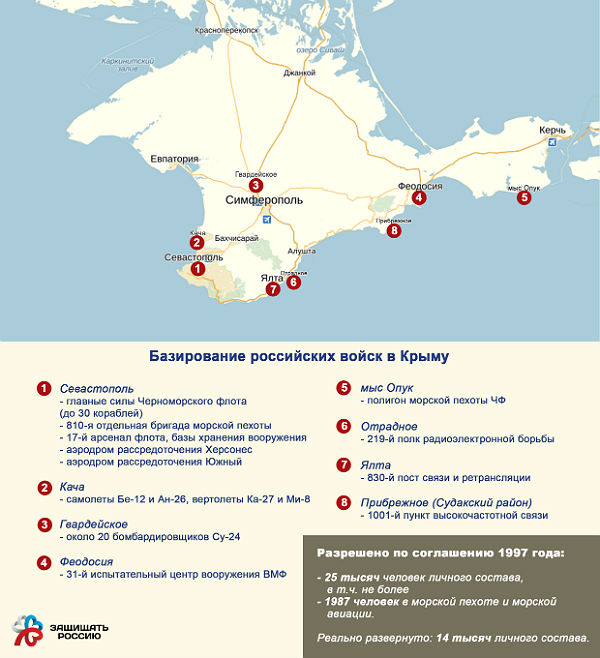
The legend reads as follows:

The 1997 agreement permits a maximum of 25,000 personnel, including no more than 1,987 naval infantry and naval aviation personnel. 14,000 are actually deployed.

1) Sevastopol: main Black Sea Fleet forces, up to 30 ships; 810 naval infantry brigade; 17th arms storage facility, Khersones and Yuzhnyi airfields.

2) Kacha airfield: Be-12 and An-26 aircraft, Ka-27 and Mi-8 helicopters.

3) Gvardeiskoe airfield: 20 Su-24 bombers.

4) Feodosiia: 31st naval armaments testing center.

5) Cape Opuk: naval firing range.

6) Otradnoe: 219th radio-electronic warfare regiment.

7) Yalta: 830th communications post.

8) Priberezhnoe: 1001st high-frequency communications post.

——————-

This comment is also available on Russian Military Reform.

Related Topics
  • Crimea
  • Gorenburg
  • Russia
  • Ukraine
Previous Article
  • In the News | Hовости

Евросоюз может временно прекратить выдачу всех виз россиянам

  • March 5, 2014
  • Vladimir Gel'man
View
Next Article
  • In the News | Hовости

Госдума хочет расследовать дело снайперов в Киеве

  • March 6, 2014
  • Olexiy Haran
View
You May Also Like
View
  • Commentary | Комментарии
  • Recommended | Рекомендуем

Clearing the Air: Secretary Blinken Visits Ukraine

  • Volodymyr Dubovyk
  • September 19, 2023
View
  • Commentary | Комментарии
  • Recommended | Рекомендуем

Ensuring Genuine Results? A New Electoral Design in Uzbekistan

  • Akrom Avezov
  • May 19, 2023
View
  • Commentary | Комментарии
  • Recommended | Рекомендуем

Ukraine, Taiwan, and Macron’s “Strategic Autonomy”

  • Maurizio Delli Santi
  • April 30, 2023
View
  • Commentary | Комментарии
  • Recommended | Рекомендуем

Russia’s Regional Governors: Backing the War, Upholding the Status Quo

  • Irina Busygina and Mikhail Filippov
  • April 7, 2023
View
  • Commentary | Комментарии
  • Recommended | Рекомендуем

The Desire to Possess: Russia’s War for Territory

  • Irina Busygina
  • February 8, 2023
View
  • Commentary | Комментарии
  • Recommended | Рекомендуем

Kyiv-Washington Relations in Times of Colossal War: The Ultimate Test of a Strategic Partnership

  • Volodymyr Dubovyk
  • January 11, 2023
View
  • Commentary | Комментарии
  • Recommended | Рекомендуем

Prevailing Soviet Legacies

  • Irina Busygina and Mikhail Filippov
  • December 27, 2022
View
  • Commentary | Комментарии
  • Recommended | Рекомендуем

In Russia’s Nuclear Messaging to West and Ukraine, Putin Plays Both Bad and Good Cop

  • Simon Saradzhyan
  • December 23, 2022

Leave a Reply Cancel reply

Your email address will not be published. Required fields are marked *

PONARS Eurasia
  • About Us
  • Membership
  • Policy Memos
  • Recommended
  • Events
Powered by narva.io

Permissions & Citation Guidelines

Input your search keywords and press Enter.